

- New
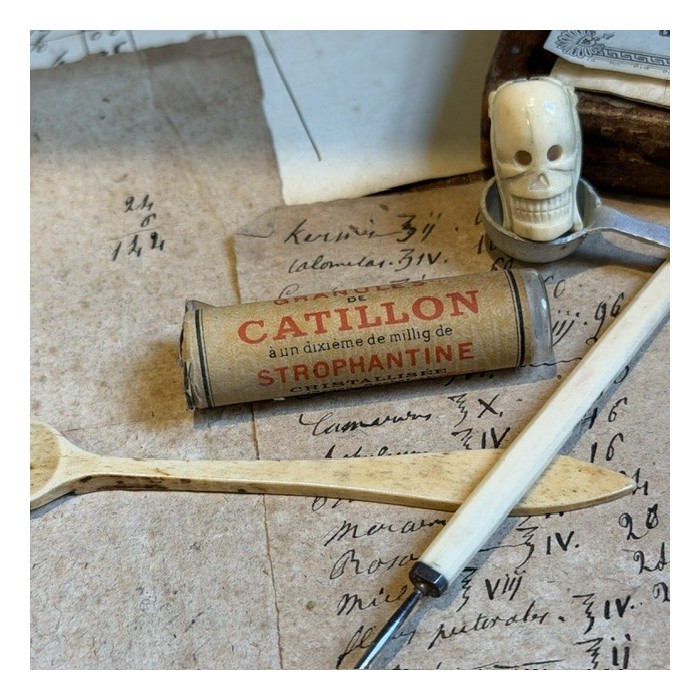
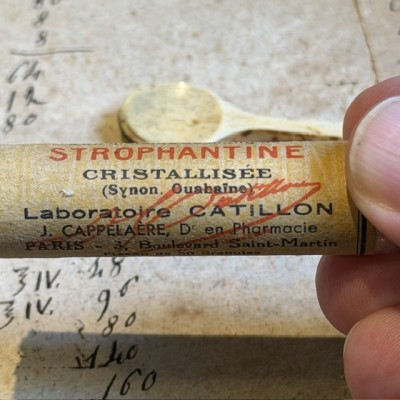
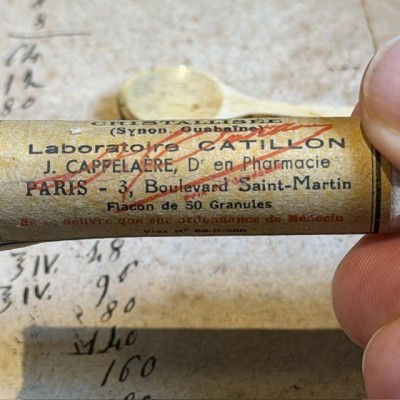
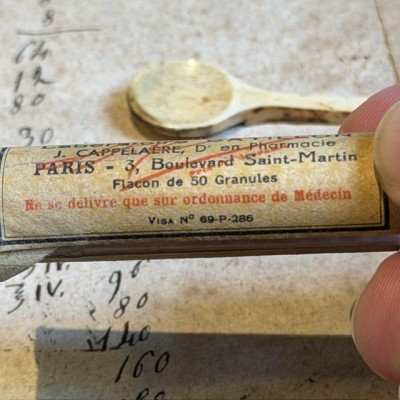
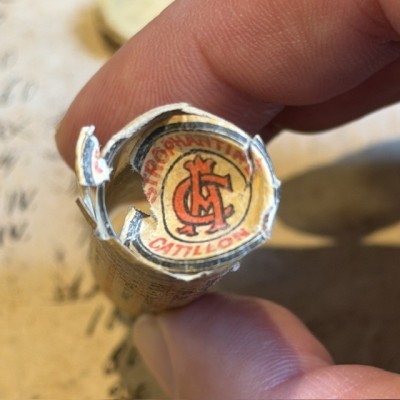
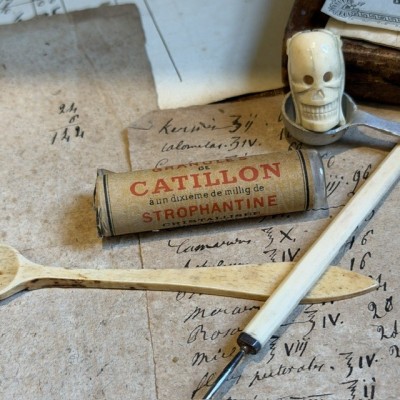
Catillon Granules – Strophanthin – Containing Ouabain
POISON
Antique tube of pharmaceutical granules – Apothecary
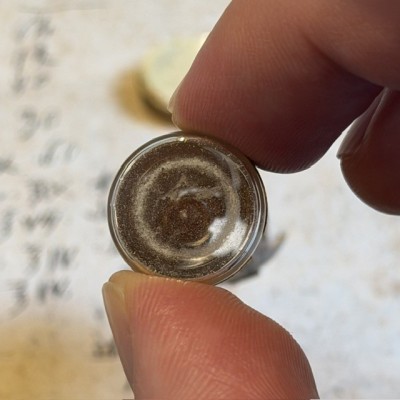
EMPTY
Catillon Granules – Strophanthin – Containing Ouabain
POISON
Antique tube of pharmaceutical granules – Apothecary
At the end of the 19th century, the chemist Léon Arnaud received poison-coated arrows from Somalia from a famous traveller of the time, Bénédict-Henry Révoil. One of them was coated with waba, a deadly poison derived from a plant known as Ouabaïo.
In 1888, he isolated the compound responsible for the poison’s effects, which he named ouabain, a potent cardiac toxin that was once used therapeutically as a cardiotonic. However, due to its toxicity, its use has since been abandoned in favour of more manageable synthetic molecules or digoxin.
In the late 19th and first half of the 20th century, this product was prescribed as a powerful cardiac stimulant, mainly to treat acute heart failure and arrhythmias. It acted in a similar way to digitalis, but with an effect often considered to be faster.
However, its strophanthin or ouabain tends to accumulate in the body if doses are taken too close together. A patient taking these granules without strictly adhering to the prescription could, after a few days, unwittingly reach a toxic total dose in the blood, leading to a heart attack!
During the 20th century, accidents linked to this type of granule were well known...
Tube length: 5cm
It comes from the old cellar-laboratory of a Parisian pharmacy. The bottles had not been moved from the shelves since the late 1950s. The cellar had served as a medical analysis laboratory and a laboratory for the pharmacy’s compounded preparations from 1900 until around 1950.
Empty
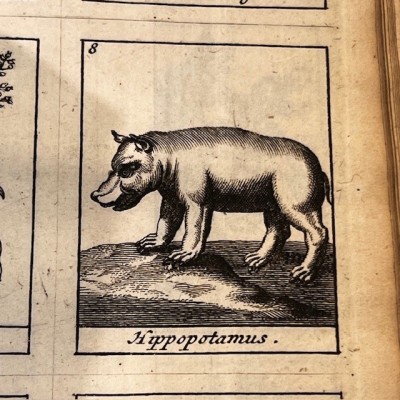
Dictionnaire Universel des Drogues Simples
Universal dictionnary of Simple Drugs
By Nicolas Lemery
An antique illustrated pharmacopoeia from 1727 - A Dutch pirated edition
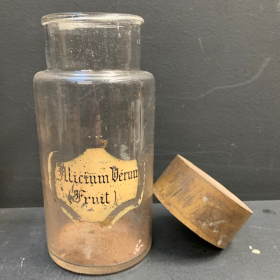
Antique pharmacy jar: Illicium verum (Fruit) / Star anise
Glass pharmacy bottle - XIXth century
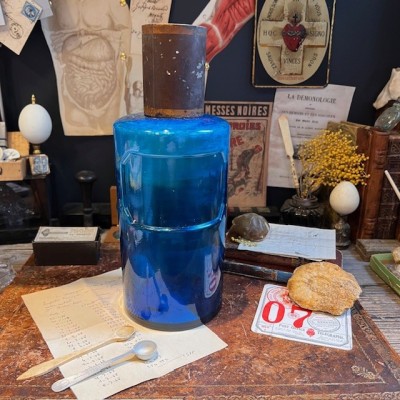
Very Large cobalt blue glass pharmacy bottle - Apothecary - Shouldered - H27.5cm - 19th century
Shouldered apothecary bottle - Antique pharmacy bottle
Mouth-blown glass - Cobalt blue color tinted throughout
This large-capacity jar was a storage jar intended for stockpiling
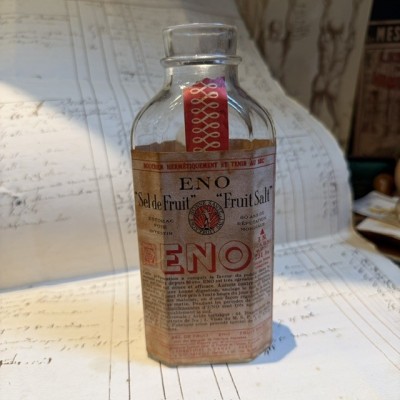
Sel de Fruit ENO - ENO Fruit Salt
Antique pharmacy bottle
EMPTY
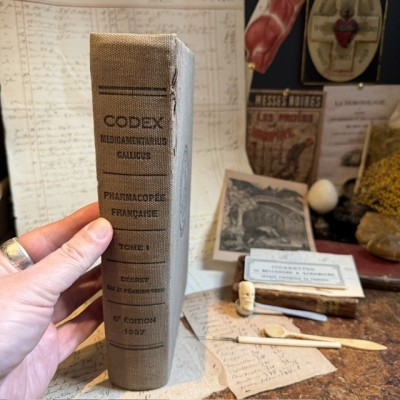
1937 Codex – French Pharmacopoeia
6th Edition – Decree of 21 February 1937
Volume I only
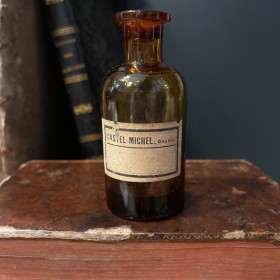
Castel - Michel perfumers
Antique perfume bottle
Apothecary vial
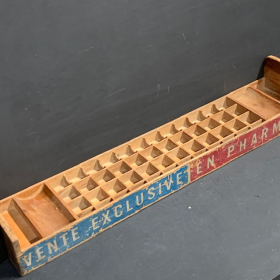
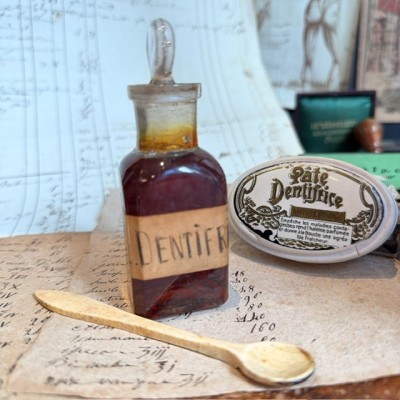
Toothpaste elixir
Antique pharmacy bottle
Handwritten label with pen
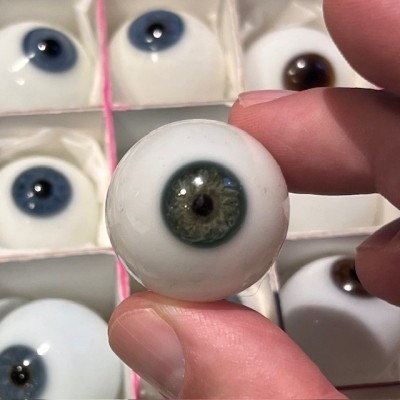
Antique glass eye - Semi-finished
Genuine antique ocular prosthesis
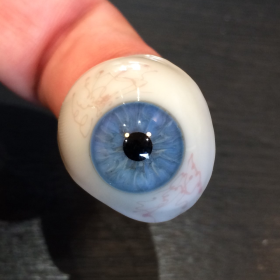
Color variations and irises of different sizes
The price is per unit, for one eye only

Lower part of the lower mandible of a horse jaw
Antique model from Maison Auzoux in Paris
Paper-mâché pedagogical model
Model A - 9 months

Grams / Tablespoons - Graduated bottle
in French: Grammes / Cuillères à soupe
Antique medicine bottle
Apothecary
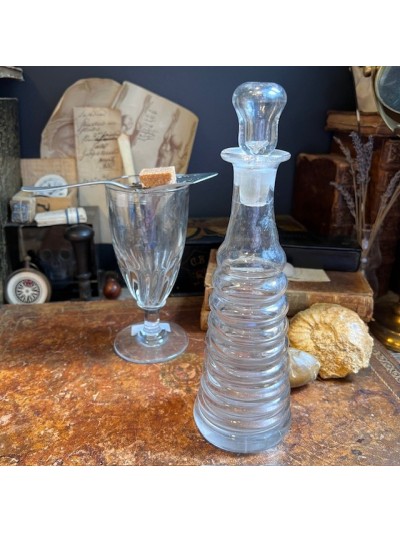
An antique absinthe topette (decanter)
10 Beaded Topette
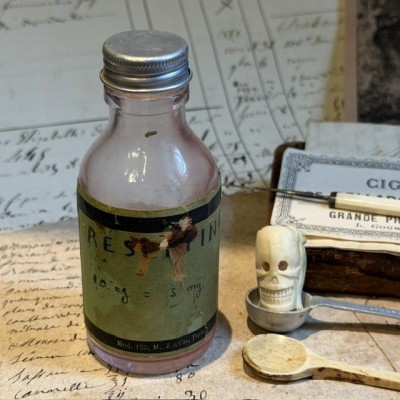
Reseptine
Antique pharmacy bottle
EMPTY
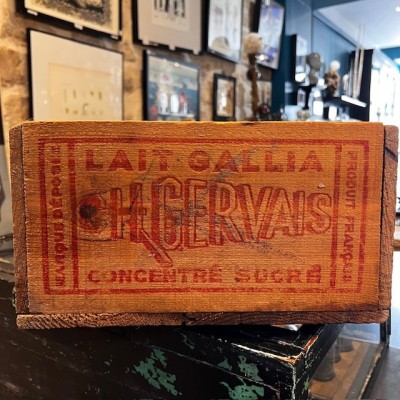
Antique wooden advertising crate for Gallia / Ch. Gervais infant milk concentrate
Found in Parisian cellars that served as laboratories and storage rooms for pharmacists preparing their masterful concoctions from 1900 to 1950.
It was used to store products, glass bottles, etc.
Period: Circa 1947–1955
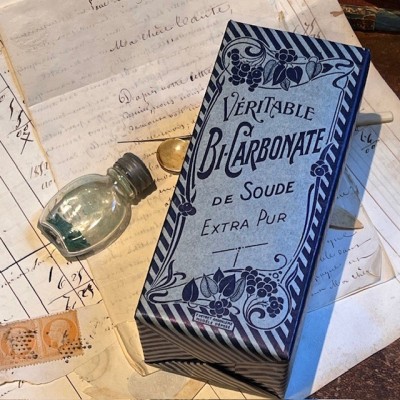
Bi-Carbonate de Soude - Sodium bicarbonate
Antique cardboard pharmacy box
Beautiful typography typical of the Belle Époque: circa 1910-1920
Catillon Granules – Strophanthin – Containing Ouabain
POISON
Antique tube of pharmaceutical granules – Apothecary
EMPTY