

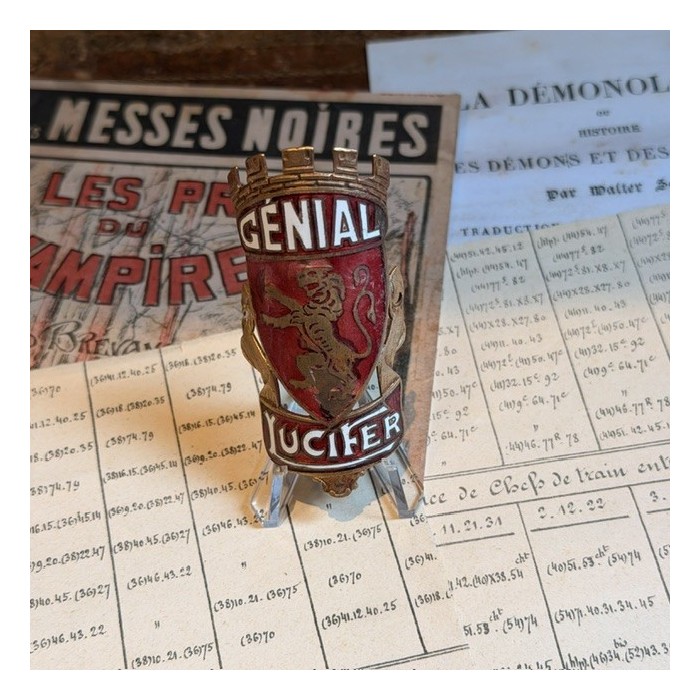
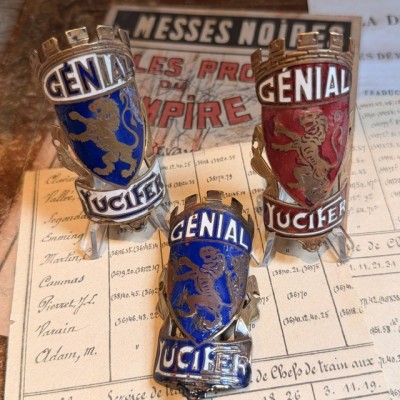
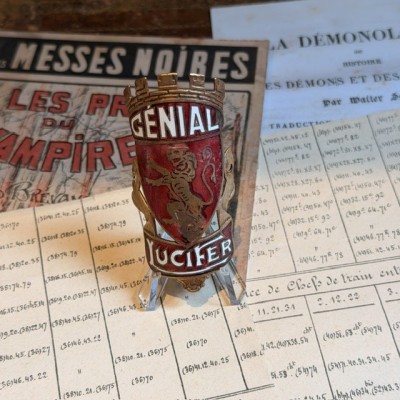
"Génial Lucifer"- Vintage bicycle headbadge
Brass & Red Enamel to be placed on the bicycle tube at the front
The 1930s
Génial Lucifer
Vintage bicycle headbadge - 1930
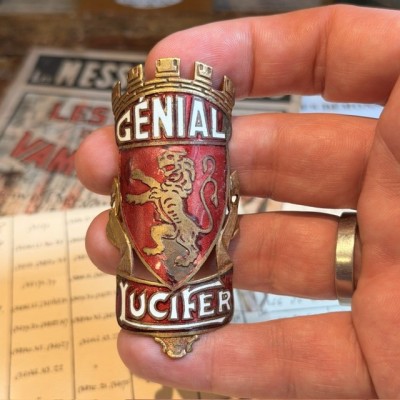
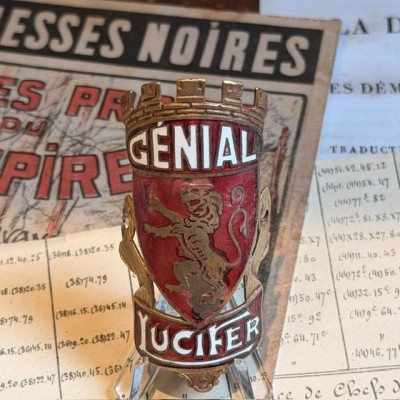
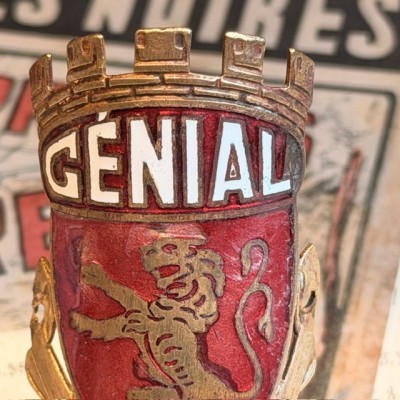
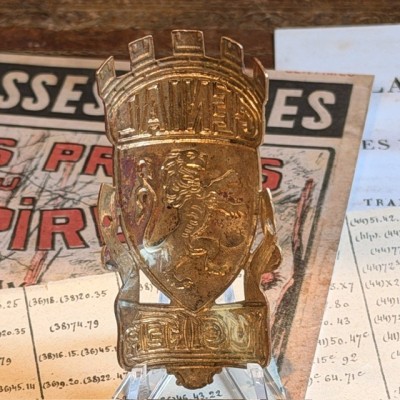
Period piece in brass characterized by its upper cut-out in crenellated crown.
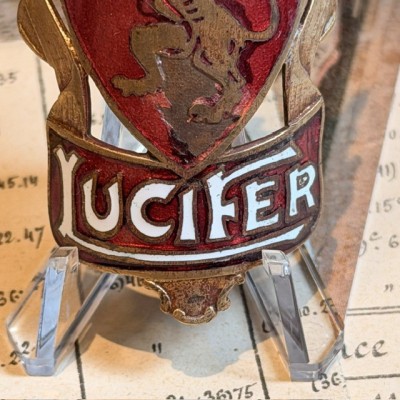
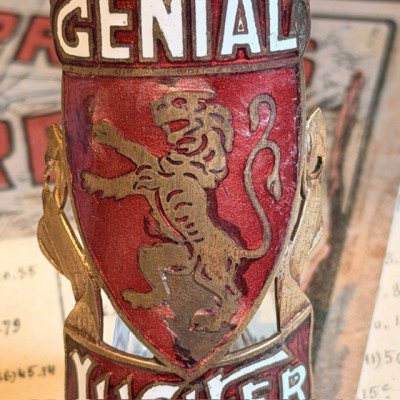
The heart of the coat of arms, enhanced with a deep Red enamel, bears the emblem of the brand: an imp.
Not to be confused with a lion!
The reliefs at the back of the plate better reveal the characteristic details of the devil: a head topped with small horns and the clearly forked tail (bifid) engraved in the matrix.
The lettering "GÉNIAL" and "LUCIFER" frame the embossed coat of arms on a white enamel background.
Red and white enamel paint on a curved brass plate to fit on the frame of a bicycle.
Date from the 1930s with a very beautiful typography.
Why a name like that for a bike?
This plate bears witness to a major industrial alliance between the two world wars. It was born from the merger, in 1930, between the establishments Génial (a famous Lyon manufacturer of frames founded in 1907 by Louis Mouterde) and the Parisian brand of cycles Lucifer. The latter was created in 1902 by the supply house Mestre & Blatgé, located on avenue de la Grande-Armée in Paris.
The name Lucifer originally played on its Latin etymology Lux Fero, the bearer of light, evoking the progress of the time, but the company chose to illustrate it in a heraldic way by an imp.
This gave society Génial Lucifer!
During its golden age (from the 1930s to the 1950s), Génial-Lucifer will shine at the top of French cycling by equipping great champions of the Tour de France such as Charles Pélissier or Jean Robic, before ceasing production in 1956
Material: Brass, Red and white enamel.
Dimensions: Height: 7cm - Maximum width: about 3cm
Condition: Authentic vintage. Natural oxidation and patina of time, enamel with cracks or minor gaps that highlight its history. The lateral attachment eyelets are intact.

Aqua Piris - Pear water
Antique pharmacy jar
Apothecary
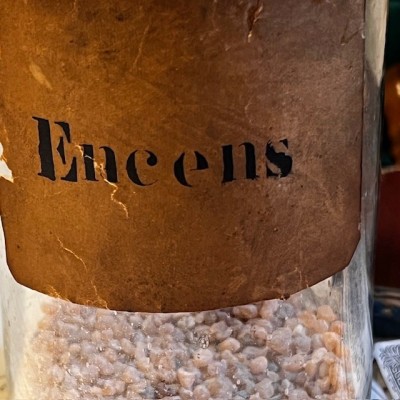
Incense
Antique pharmacy bottle - Wide-mouth apothecary jar.
19th-century mouth-blown glass
There are still some product inside.
A fascinating artifact from the history of pharmacology
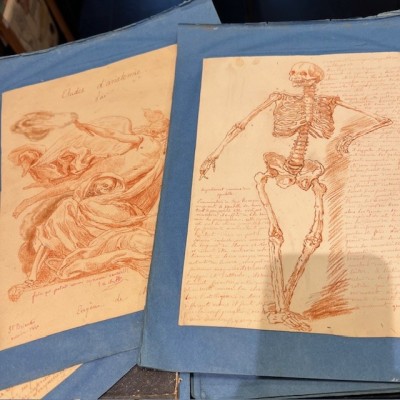
Red chalk drawing- Anatomical drawing
Anatomical study
Drawn by Eugène de Montchoisy in Saint-Brieuc in November 1840
These are not reproductions but original period drawings in red chalk.
You are purchasing one plate, not the entire set of plates
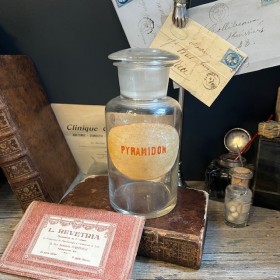
Pyramidon
Antique pharmacy bottle
Apothecary vial
Color pigments have been added to the inside of the jar
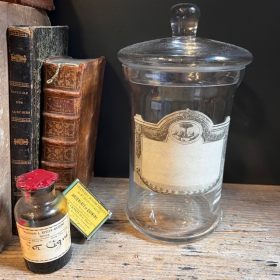
Herbalist's or Pharmacist's jar
Antique blank label of the XVIIIth century
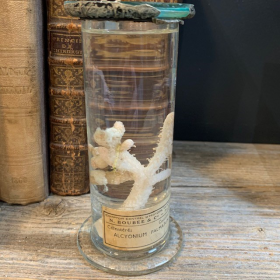
Museum jar - Wet specimen
Soft coral Alcyonium palmatum
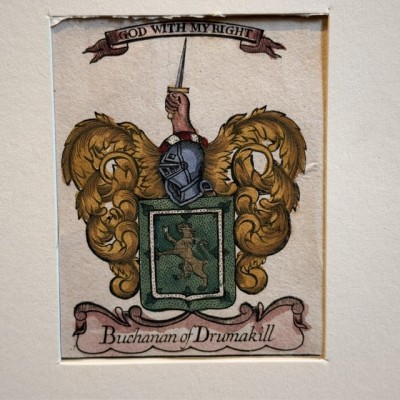
Original heraldic engraving on copper (1722) in colour - A System of Heraldry - By Alexander Nisbet
The vignette was cut from an original folio sheet and then hand-enhanced with a subtle watercolor painting.
The event is presented under a modern passe-partout
Coat of arms of the family: Buchanan of Drumakill

Racine de Ratanhia - Para Rhatany
Pharmacy jar - Herbalism - Apothecary bottle
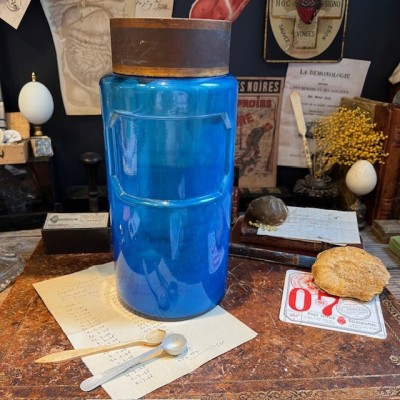
Cobalt blue glass pharmacy jar - Apothecary - Wide neck - H26cm - 19th
Apothecary jar with wide opening. Antique pharmacy bottle
Mouth-blown glass - Cobalt blue color tinted throughout
This large-capacity jar was a storage jar intended for stockpiling
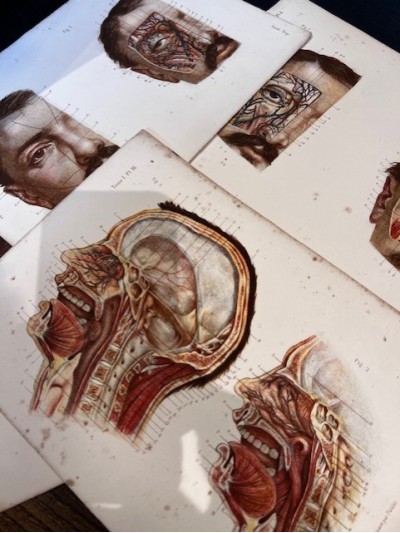
Anatomical chart by Paulet and Sarazin
From the Traité d'anatomie topographique (Treatise on topographical anatomy)
Published in 1867-1870
Chromolithography
You buy 1 plate, not the whole set

Cours d'opérations de chirurgie, démontrées au Jardin Royal
Course of surgical operations, demonstrated in the Royal Garden
Published in 1751 in Paris, by d'Houry, sole printer and bookseller to Monseigneur le Duc d'Orléans
Fourth edition
Illustrated with numerous plates and engravings in the text, including the famous plate of Poor Malabou and her scrotal elephantiasis on page 112/113, which the author mentions on page 373.
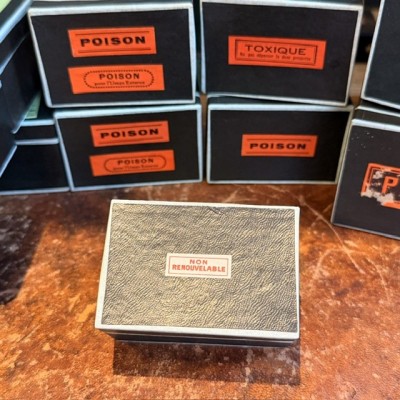
Antique labels in a pharmacy box for cures made of canvas cardboard
Non-renewable label
The pharmacist used his boxes of medicine to put away the labels he would then put on the bottles that he would resell to his customers.
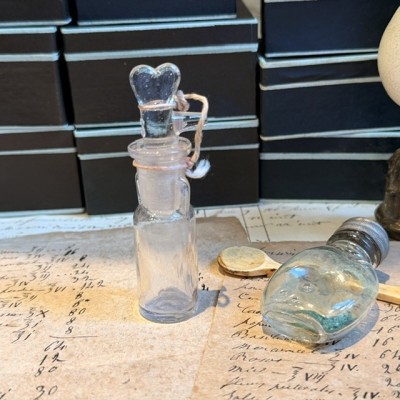
Dropper bottle
Antique pharmacy bottle - 1920-30's
Glass stopper honed in the shape of a heart for better grip
EMPTY
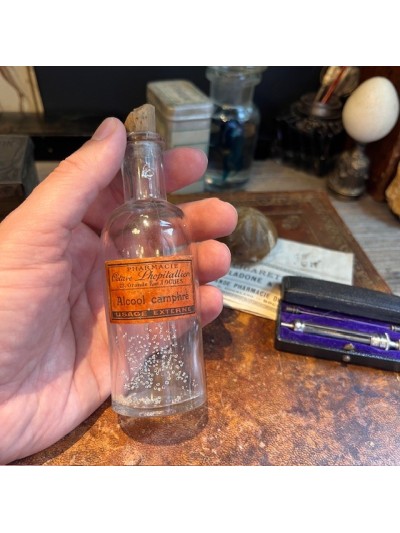
Camphorated alcohol
Antique pharmacy bottle
Apothecary vial
EMPTY
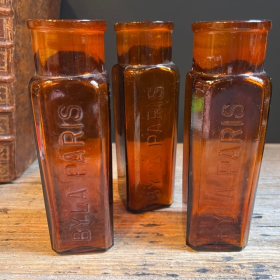
BYLA - Antique Pharmacy bottle in amber glass
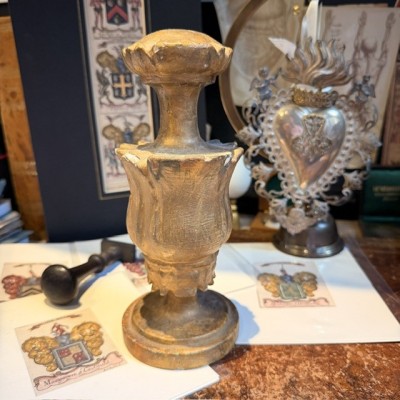
Stem - Baroque base in turned wood and gilded stucco - Italy (Tuscany), 19th century
Italian Giltwood Altar Floral Stand
Antique religious altar bouquet stem made of turned and carved wood, covered with a stucco undercoating (gesso) and gilded.
Lack of gesso and gilding in some places, which is precisely why the white gesso appears under the gilding.
Traces of use and visible gaps in stucco
"Génial Lucifer"- Vintage bicycle headbadge
Brass & Red Enamel to be placed on the bicycle tube at the front
The 1930s