
- New
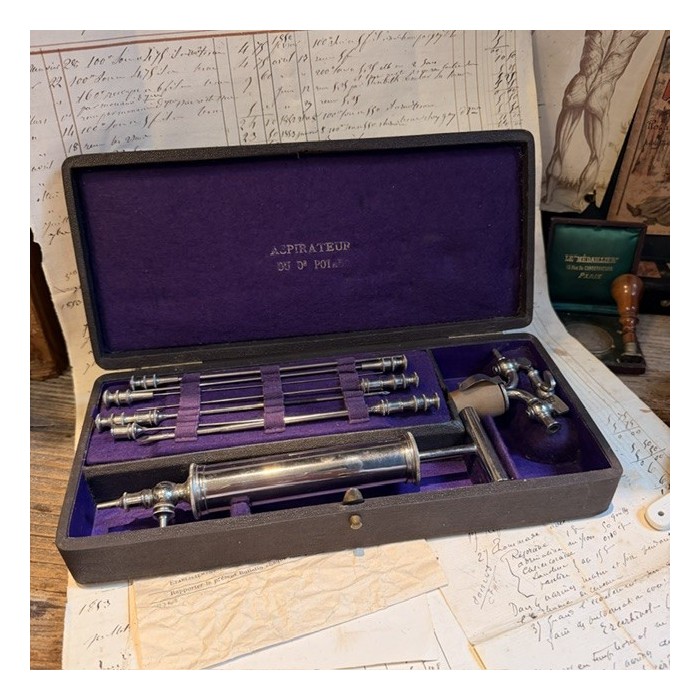
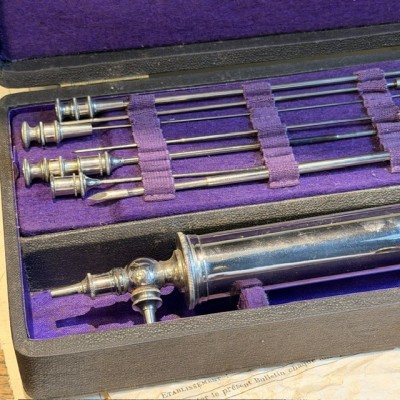
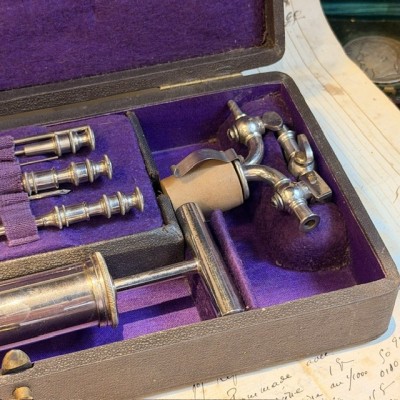
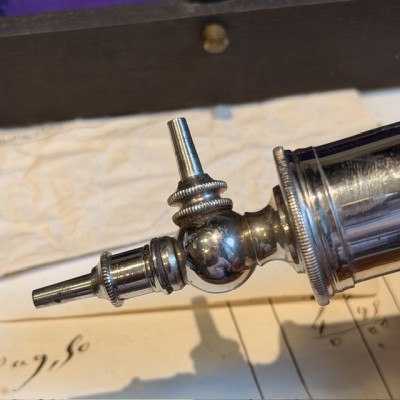
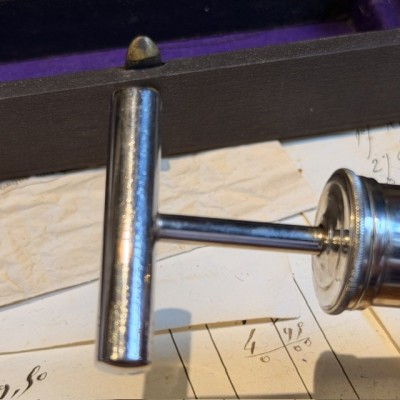
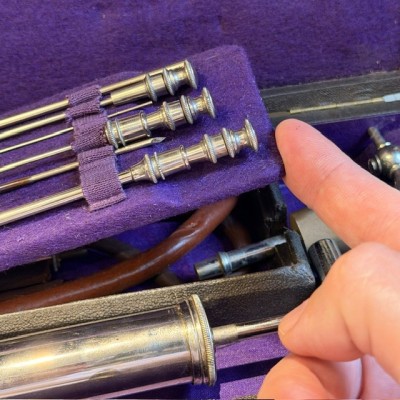
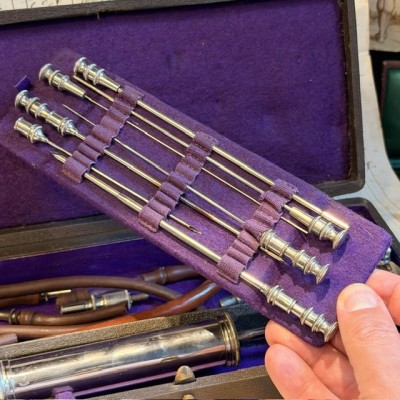
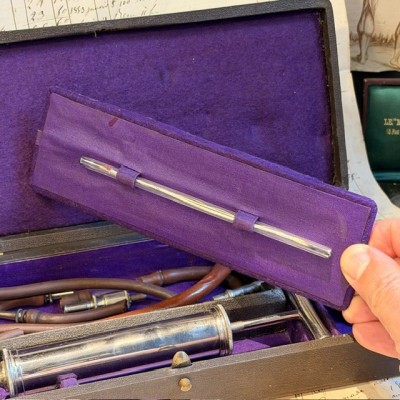
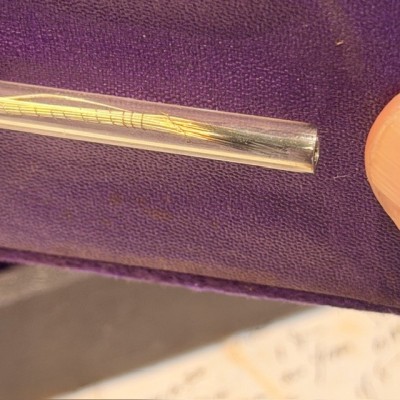
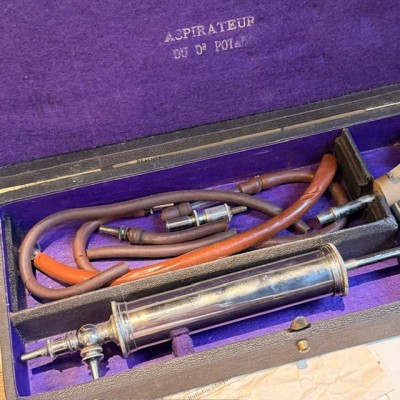
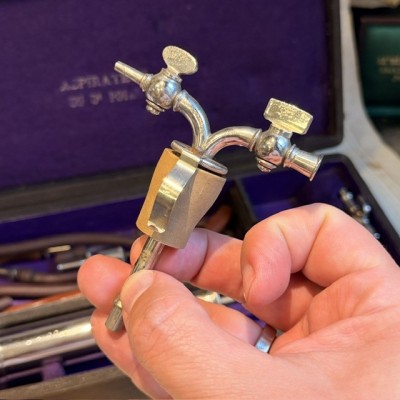
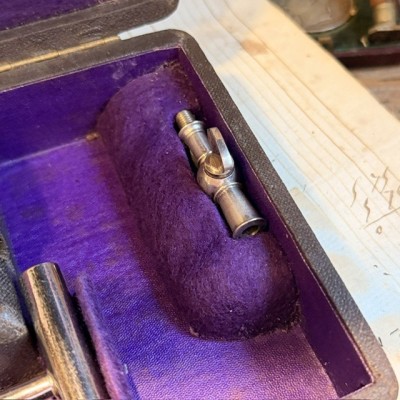
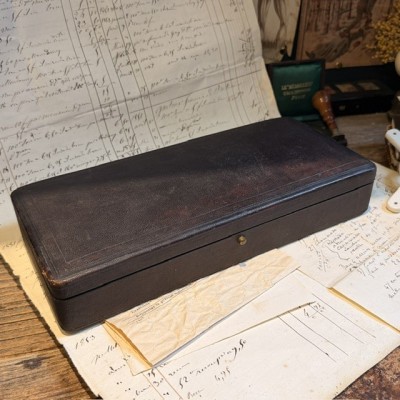
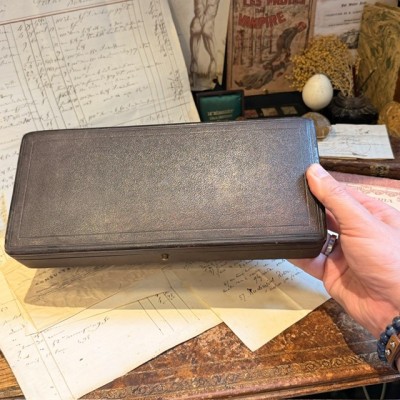
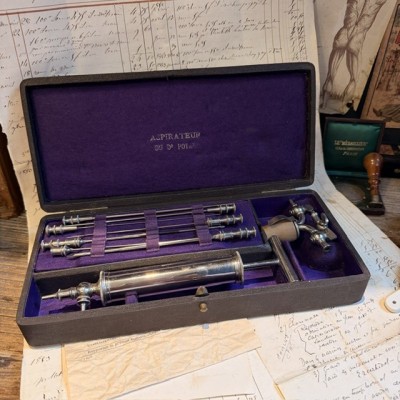
Dr. Potain’s aspirator set in its felt-lined box
Late 19th century, circa 1880
Antique medical instrument without manufacturer marking
non-functional
Dr. Potain’s aspirator set in its felt-lined box
Late 19th century, circa 1880
Antique medical instrument without manufacturer marking
This instrument was used to evacuate fluids, particularly for pleurisy — an inflammation of the pleura, the membrane surrounding the lungs, which often causes fluid build-up in the pleural cavity.
It could also be used to drain urine from a retained bladder or release gas from an intestinal strangulation caused by a hernia. Additionally, it could be used to inject fluids.
(Source: Conservatoire du Patrimoine Hospitalier de Rennes).
The set is complete, but the rubber tubing has not survived over time; the rubber has hardened and breaks into small pieces if handled.
Includes:
One steel pump equipped with two fittings at its end.
One double-conduit hollow metal rod branching into two tubes, each fitted with a stopcock.
Trocars of various gauges, junto with canulas and blunt stylets.
Case dimensions: 27.5 x 12 x 5.5 cm
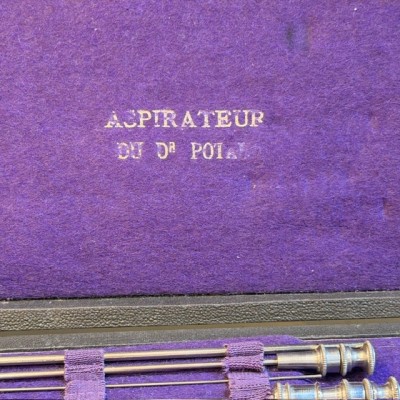
Marking of Dr. Potain’s aspirator on the inner felt.
Case covered in black pebbled leather with blind-stamped borders on top. Push-button latch. Typical box manufacturing from the 1870–1895 period.
Non-functional.
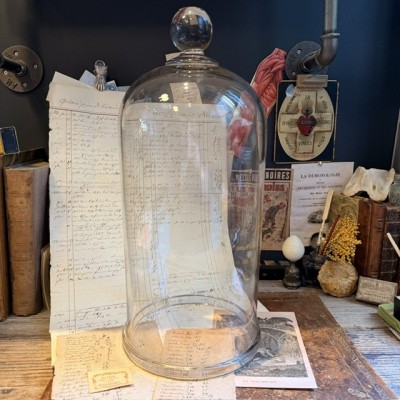
Protective laboratory bell jar - High form with knob in blown glass
Period: 1900 - Pharmacy - Apothecary
Used by the pharmacist to cover precision instruments or isolate preparations undergoing analysis
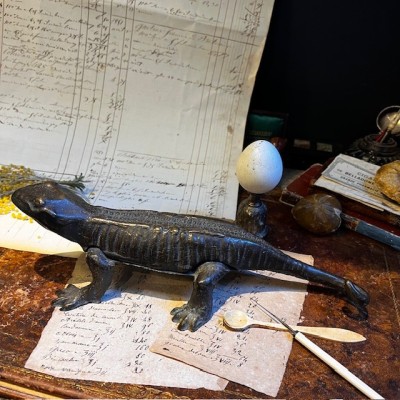
Salamander - Pharmacy corkscrew in bronze
XIXth century

Human jaws in porcelain mounted on a blackened wooden base
Anatomical dental model for dentists
19th century
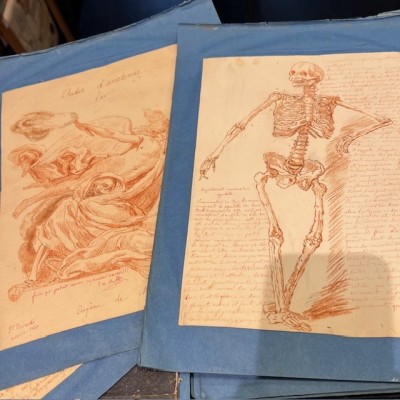
Red chalk drawing- Anatomical drawing
Anatomical study
Drawn by Eugène de Montchoisy in Saint-Brieuc in November 1840
These are not reproductions but original period drawings in red chalk.
You are purchasing one plate, not the entire set of plates
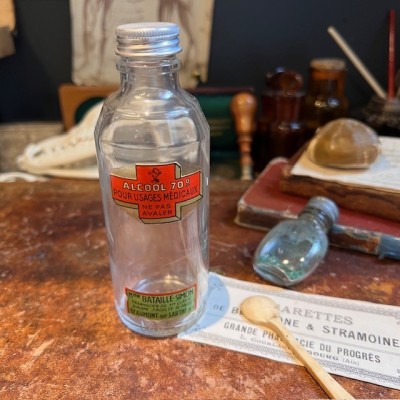
70° alcohol
Antique pharmacy bottle - Apothecary
Mrs Bataille-Simon, First Class Pharmacist in Beaumont sur Sarthe - Tel 9
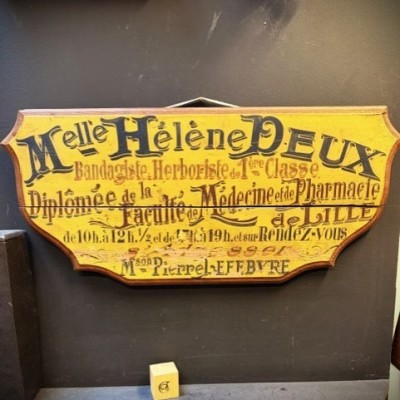
Rare and authentic wall sign panel
Pharmacy and fitting brand - Miss Hélène Deux, Bandagiste & 1st class Herbalist
Officine sign panel in painted wood from the 19th-20th century hinge: 1890-1920.
The sign is made of 2 reinforced wood panels at the back. There is a space between the 2 panels.
The sign features a superb art lettering entirely made freehand by a letter painter (superb contrasts of blue and brown, neat full and loose)
Witness to the history of pharmacy and ancient orthopaedics: the bandagist shaping leather and frames for corsets and restraints, and the herbalist 1st class, a profession that has disappeared since the abolition of the diploma in 1941.
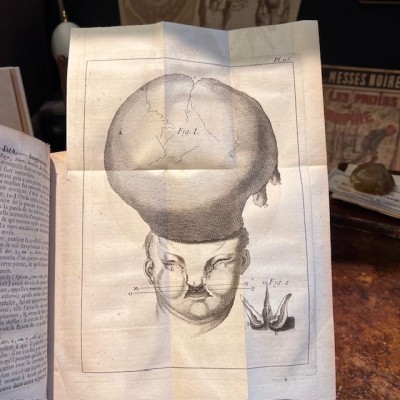
Bibliothèque Choisie de Médecine - Volume 16
Selected Library of Medicine
By François PLANQUE - 1761
Complete original edition with 10 fold-out plates
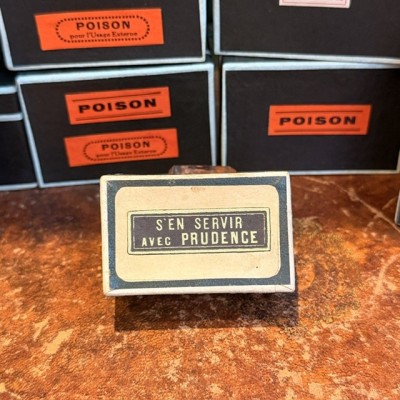
Antique labels in a pharmacy box for cures made of canvas cardboard
Use it with caution label
The pharmacist used his boxes of medicine to put away the labels he would then put on the bottles that he would resell to his customers.
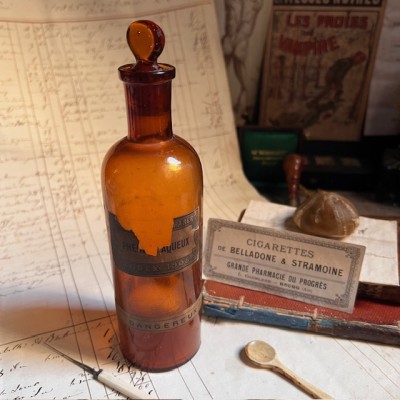
Phénol Aqueux
Antique pharmacy bottle
Green label: SUBSTANCE TO BE SEPARATED - CODEX 1908
This means that this bottle had to be kept separate from the others because it was dangerous - POISON
EMPTY
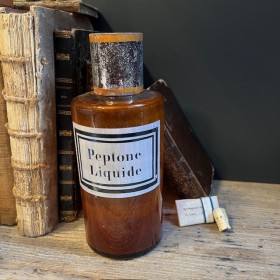
Antique pharmacy jar
Liquid Peptone
Raw meat product very fashionable in the first half of the 20th century.
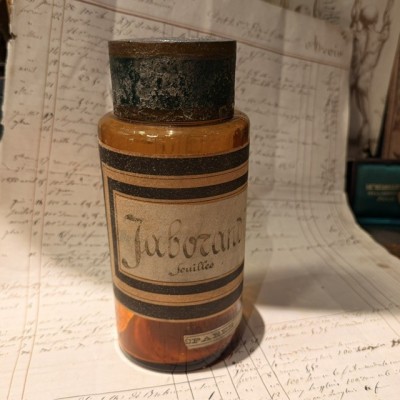
Jaborandi
Pharmacy jar - Herbalism - Apothecary Mouth-blown glass bottle
Late 19th century - Beginning of the 20th
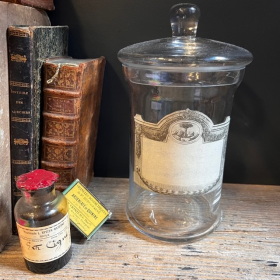
Herbalist's or Pharmacist's jar
Antique blank label of the XVIIIth century
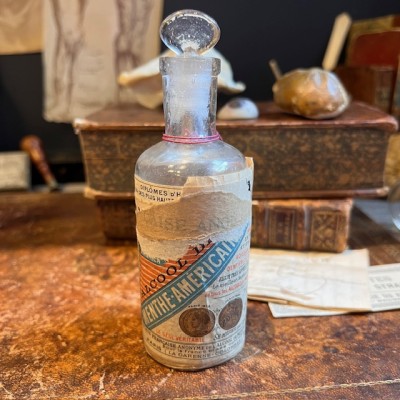
American mint alcohol
Antique pharmacy bottle
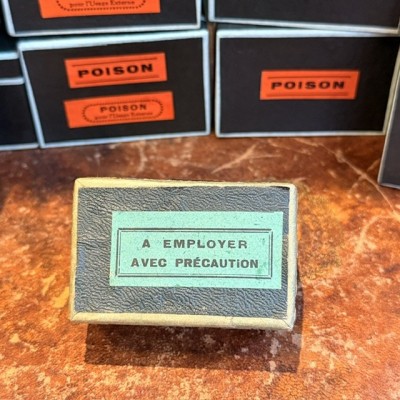
Antique labels in a pharmacy box for cures made of canvas cardboard
To be used with care label
The pharmacist used his boxes of medicine to put away the labels he would then put on the bottles that he would resell to his customers.
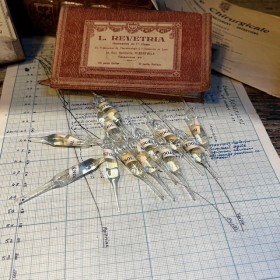
Antique ampoule for hypodermic injection
Histogénol - (circa 1900)
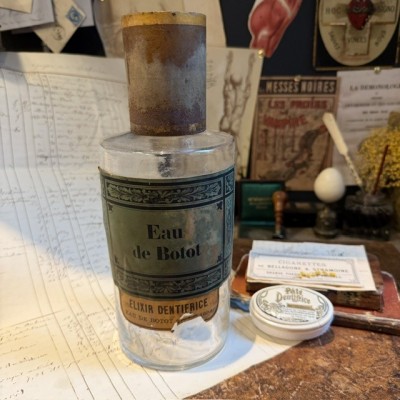
Eau de Botot - Tooth-cleansing Elixir
CODEX 1884
Antique 19th-century pharmacy bottle
EMPTY
Dr. Potain’s aspirator set in its felt-lined box
Late 19th century, circa 1880
Antique medical instrument without manufacturer marking
non-functional