
- New
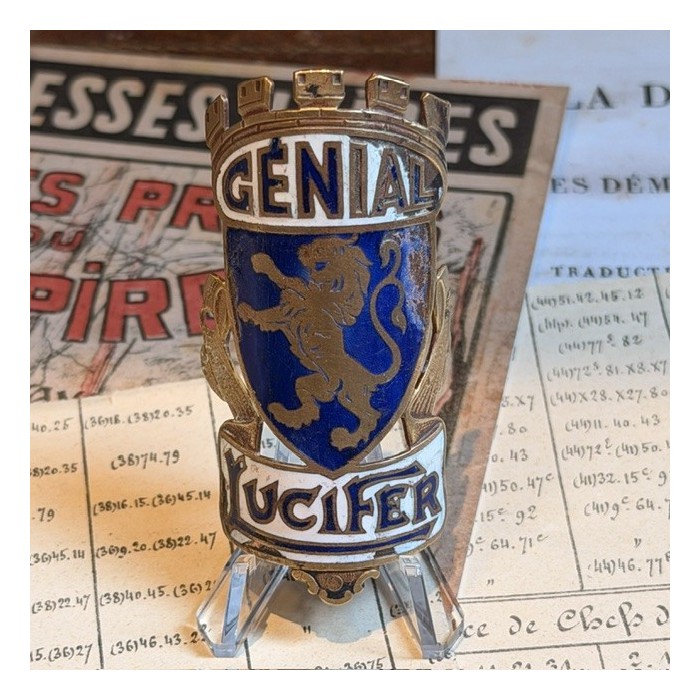
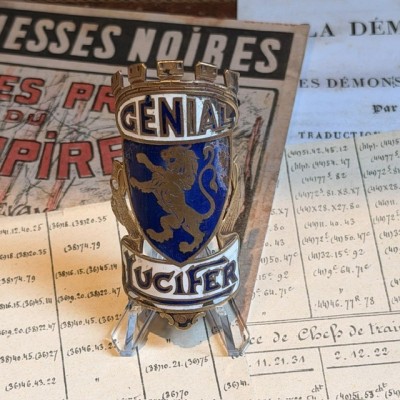
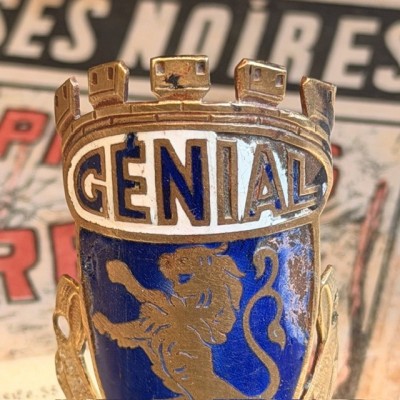
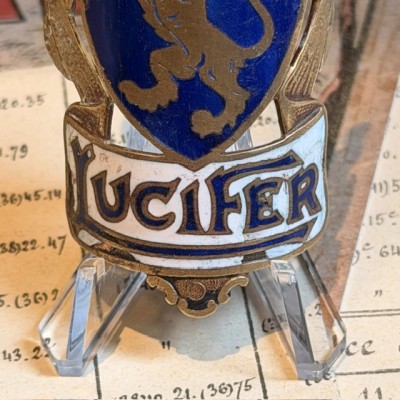
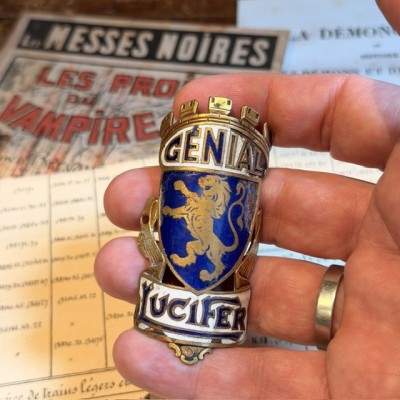
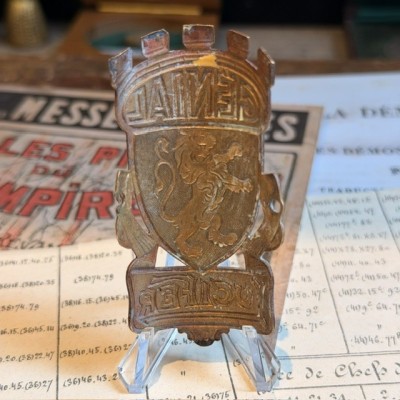
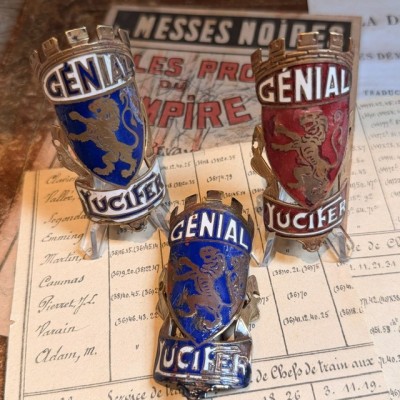
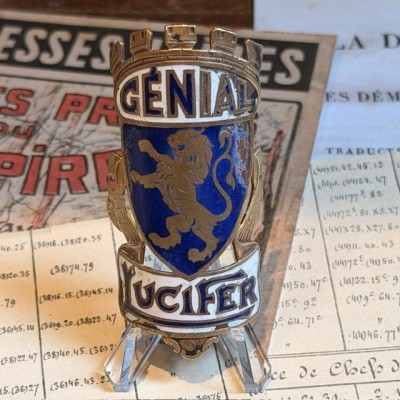
"Génial Lucifer"- Vintage bicycle headbadge
Brass & Blue Enamel to be placed on the bicycle tube at the front
The 1930s
Génial Lucifer
Vintage bicycle headbadge - 1930
Period piece in brass characterized by its upper cut-out in crenellated crown.
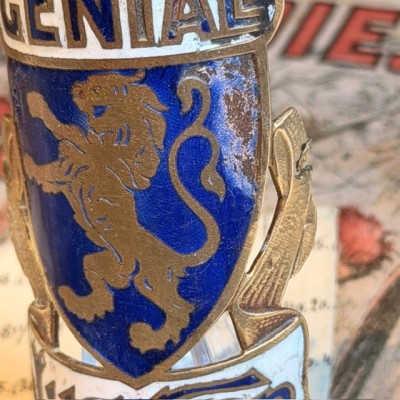
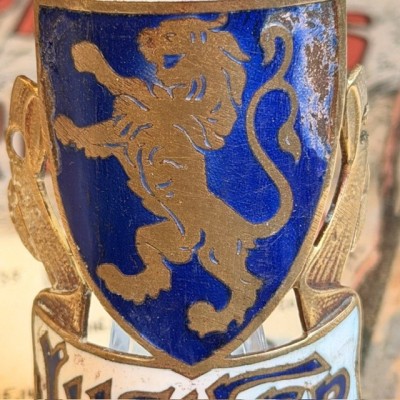
The heart of the coat of arms, enhanced with a deep blue enamel, bears the emblem of the brand: an imp.
Not to be confused with a lion!
The reliefs at the back of the plate better reveal the characteristic details of the devil: a head topped with small horns and the clearly forked tail (bifid) engraved in the matrix.
The lettering "GÉNIAL" and "LUCIFER" frame the embossed coat of arms on a white enamel background.
Blue and white enamel paint on a curved brass plate to fit on the frame of a bicycle.
Date from the 1930s with a very beautiful typography.
Why a name like that for a bike?
This plate bears witness to a major industrial alliance between the two world wars. It was born from the merger, in 1930, between the establishments Génial (a famous Lyon manufacturer of frames founded in 1907 by Louis Mouterde) and the Parisian brand of cycles Lucifer. The latter was created in 1902 by the supply house Mestre & Blatgé, located on avenue de la Grande-Armée in Paris.
The name Lucifer originally played on its Latin etymology Lux Fero, the bearer of light, evoking the progress of the time, but the company chose to illustrate it in a heraldic way by an imp.
This gave society Génial Lucifer!
During its golden age (from the 1930s to the 1950s), Génial-Lucifer will shine at the top of French cycling by equipping great champions of the Tour de France such as Charles Pélissier or Jean Robic, before ceasing production in 1956
Material: Brass, blue and white enamel.
Dimensions: Height: 7cm - Maximum width: about 3cm
Condition: Authentic vintage. Natural oxidation and patina of time, enamel with cracks or minor gaps that highlight its history. The lateral attachment eyelets are intact.

Dry sodium iodide
Antique pharmacy bottle - drugstore - apothecary
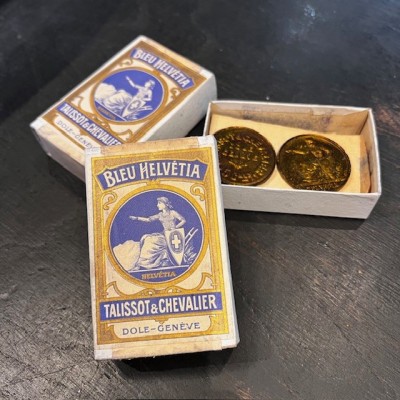
Antique Laundry blue box - Helvetia Blue from Talissot & Chevalier in Dôle and Geneva
Period: 1890-1905
Box containing 6 gold-plated “coins” made of blue wash, resembling the iconography of Swiss coins and medals from the late 19th and early 20th centuries.
Beautiful blue and gold illustration on the box.
Your box will be sealed: never opened in 120 years
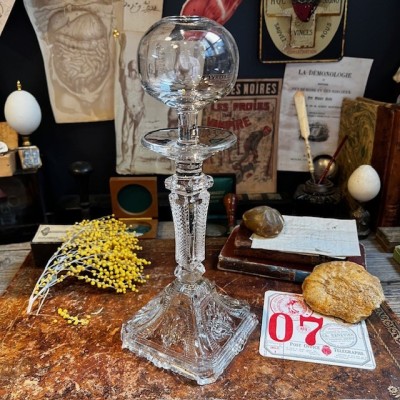
Antique glass oil lamp in pressed molded glass - Provence
19th century, circa 1880/1890
Decorated with satyr masks, ram's head and bouquet of flowers
Height 26cm
Highly transparent crystal glass with beautiful clarity
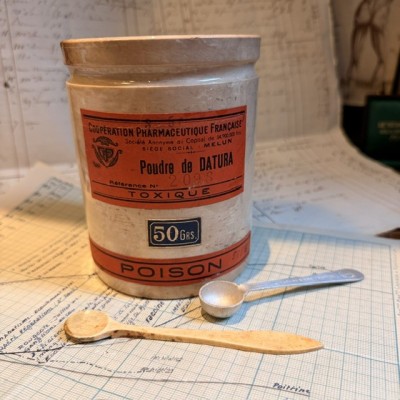
Datura powder
Antique earthenware pot
Intended for the exclusive use of pharmacists for making magistral preparations, the jar displays the regulatory labels "TOXIC" and the red banner "POISON".
Indicating to the pharmacist that it must be stored separately from other substances in the cabinet for toxic substances, the famous ‘poison cabinet’.
It comes from the former cellar-laboratory of a Parisian pharmacy. The bottles had not been moved from the shelves since the late 1950s. The cellar had served as a medical analysis laboratory and a laboratory for the pharmacy’s compounded preparations from 1900 until around 1950.
EMPTY
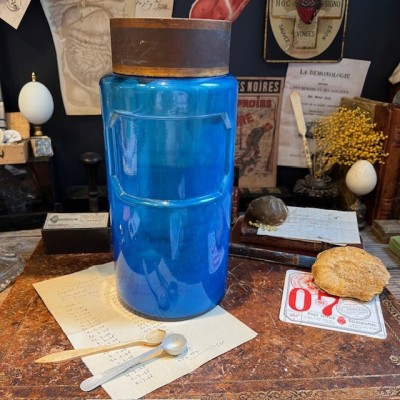
Cobalt blue glass pharmacy jar - Apothecary - Wide neck - H26cm - 19th
Apothecary jar with wide opening. Antique pharmacy bottle
Mouth-blown glass - Cobalt blue color tinted throughout
This large-capacity jar was a storage jar intended for stockpiling
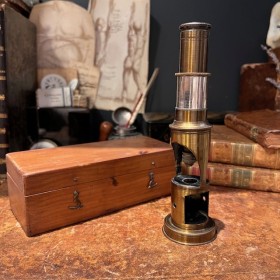
Antique drum microscope for botanist, entomologist
Mirror missing
Late 19th century, early 20th century
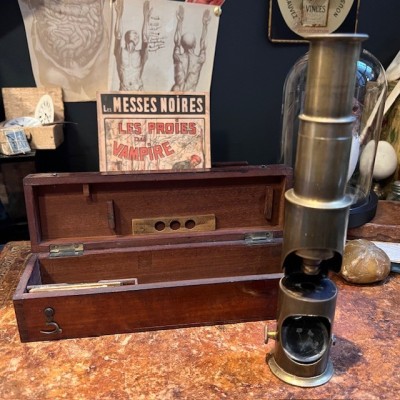
Antique and large drum microscope
In it's mahogany wooden box
For botanist, entomologist - XIXth century
This is a larger model than those usually found on the market
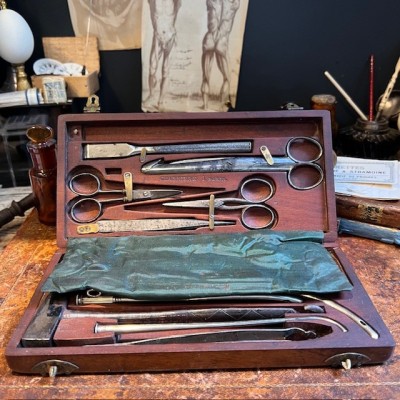
Portable autopsy kit from the mid-19th century
Maison Charrière in Paris, circa 1845–1870
Mahogany case for autopsy and dissection
Small portable mahogany case containing a set of autopsy instruments: hook hammer, bone chisel, enterotome scissors, probes, hooks and suture needles. Used by forensic scientists and anatomists for opening and examining bodies.
Charrière, a major 19th-century Parisian manufacturer, was a pioneer in the design of high-precision surgical and anatomical instruments.
Mahogany and polished steel: 23 × 11 cm
Please note: crack in the wood under the case
A beautiful object, very rare to find
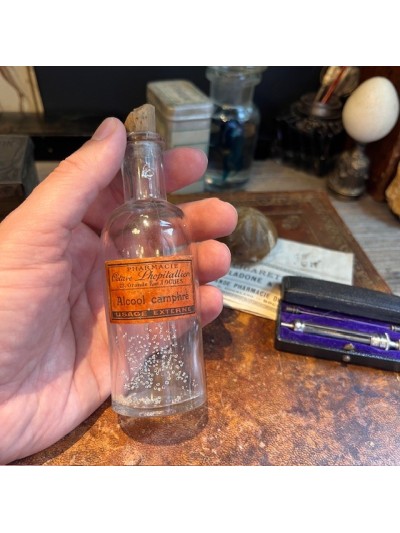
Camphorated alcohol
Antique pharmacy bottle
Apothecary vial
EMPTY
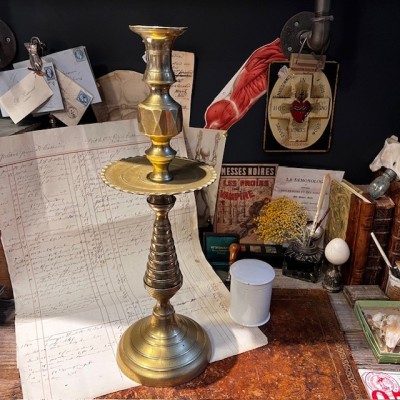
Large brass candlestick - Candleholder
20th century
Height 42cm Weight: 1.65kg
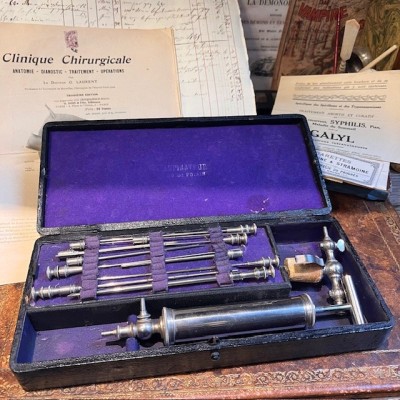
Dr Potain vacuum cleaner in its case
Late 19th century - 1870-1895
Antique medical instrument
However, the box comes from the Hôpital de la Charité in Paris, as indicated by the inscription on the top of the box, from the Bouillaud ward of the hospital.
non-functional
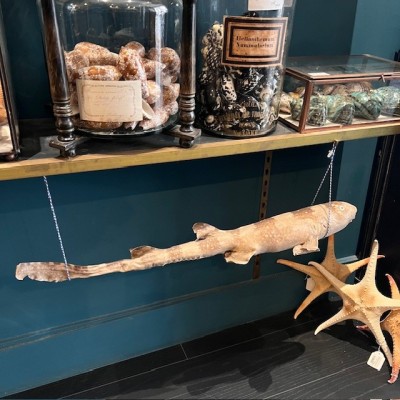
Brownbanded bamboo shark
Naturalized
Chiloscyllium punctatum
Unprotected species - Old taxidermy: visible suture under the belly and on the left side near the mouth

Antique brown glass bottle with integrated pipette - Ref B
Apothecary - Pharmacy
The pipettes have either been broken or shortened because they are too short
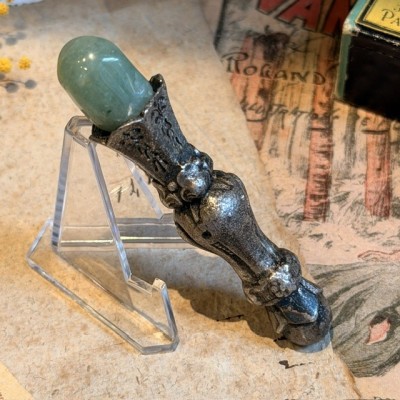
Laboratory pestle in chiseled metal and apothecary hard stone
Possibly an agate or jade
Dating: Belle Époque (Circa 1890 - 1910)
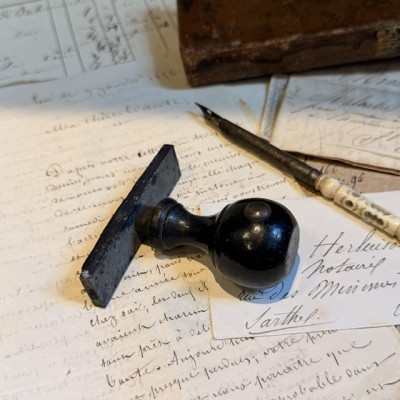
Antique manual pharmacy stamp - BERTHIER Pharmacy
The rubber base, engraved in relief, reads: ‘Pharmacie de BERTHIER / rue de Phalsbourg / PARIS’.
Sturdy metal frame and ergonomic handle made from turned blackened wood
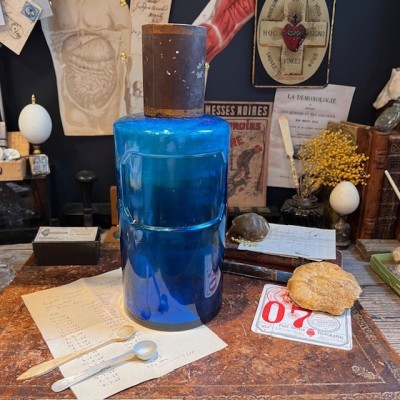
Large cobalt blue glass pharmacy bottle - Apothecary - Shouldered - H27.5cm - 19th century
Shouldered apothecary bottle - Antique pharmacy bottle
Mouth-blown glass - Cobalt blue color tinted throughout
This large-capacity jar was a storage jar intended for stockpiling
"Génial Lucifer"- Vintage bicycle headbadge
Brass & Blue Enamel to be placed on the bicycle tube at the front
The 1930s