- New
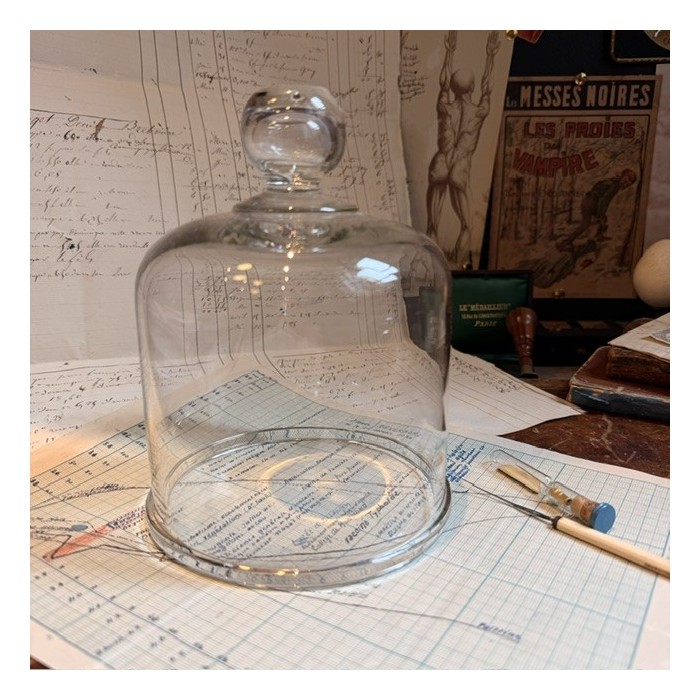
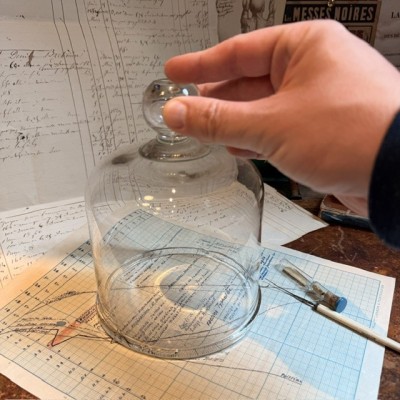
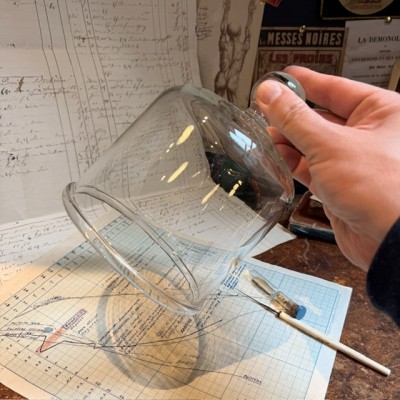
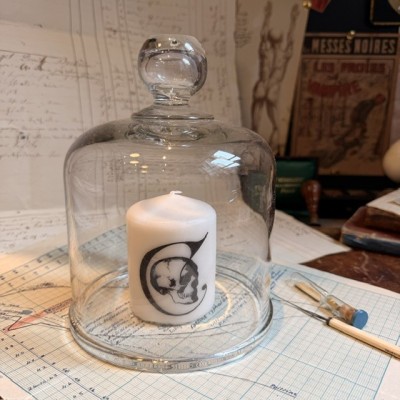
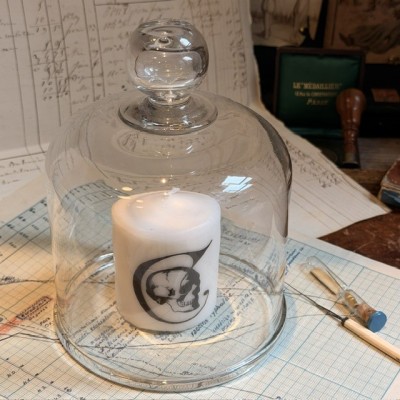
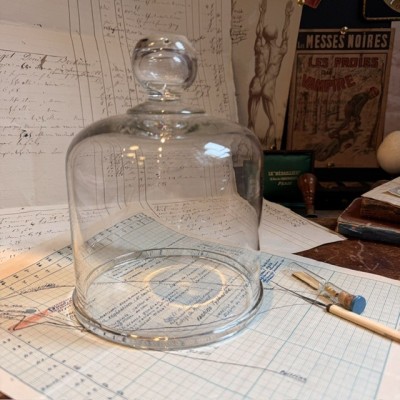
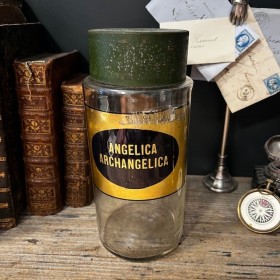
Protective laboratory bell jar - Low form with knob in blown glass
Period: 1900 - Pharmacy - Apothecary
Used by the pharmacist to cover precision instruments or isolate preparations undergoing analysis
Protective laboratory bell jar - Low form with knob in blown glass
Period: 1900 - Pharmacy - Apothecary
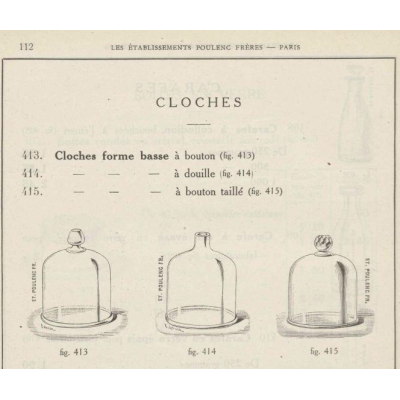
Large scientific protective bell jar in heavy blown glass, listed as "Cloche forme haute à bouton" in the general catalogue of the Maison Poulenc Frères in Paris from 1919.
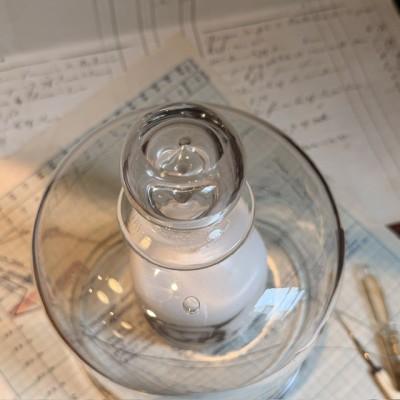
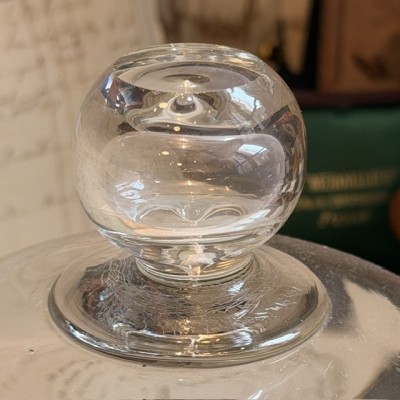
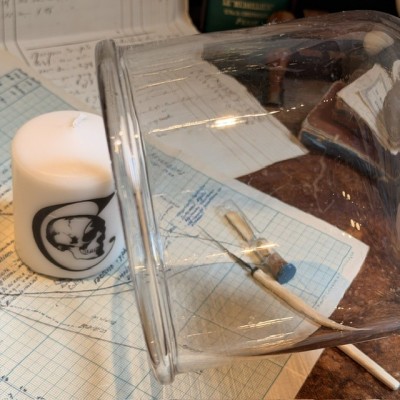
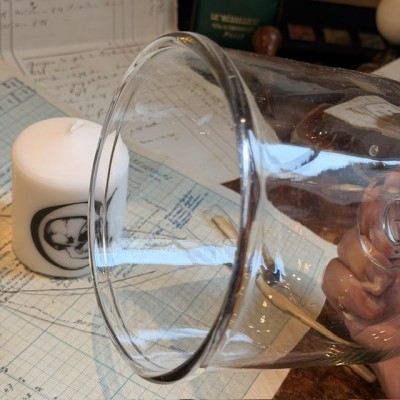
It is characterized by a button-shaped top knob offering an excellent grip and ends at its base with a thick reinforcing rim to withstand impacts on wood, marble, or tiled laboratory countertops.
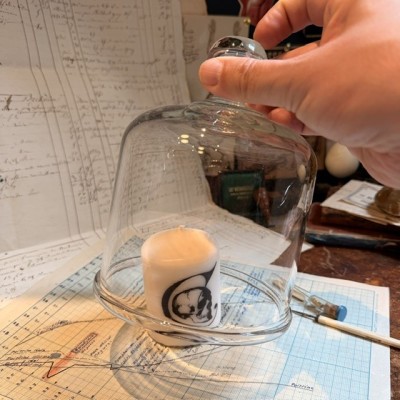
It was used by the pharmacist to cover precision instruments or isolate preparations undergoing analysis. To hermetically seal the device in order to protect it against drafts, stop contamination from laboratory dust, and block the evaporation of volatile solutions or alcohol.
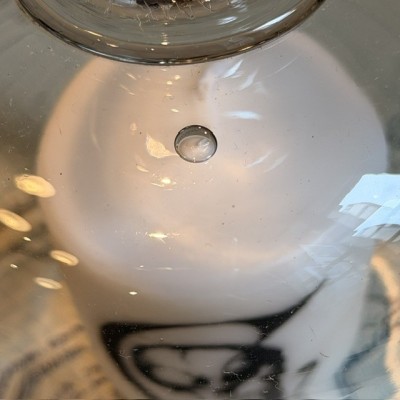
Warning the bell jar is antique, there are scratches sometimes significant in certain places, bubbles in the glass, ...
Comes from a former basement-laboratory of a Parisian pharmacy. The bottles and other utensils had not moved from the shelves since the late 1950s. The basement had served as a medical analysis laboratory and a laboratory for the pharmacy's magisterial preparations from 1900 until around 1950.
Total height: 16 cm
Internal useful height: 10.5 cm
External diameter at base: 12.5 cm
To be repurposed to protect and showcase one of your objects.

Pharmaceutical zinc sulphate
Antique amber glass bottle, with a boxwood and cork stopper.
Green label: SUBSTANCE TO BE STORED SEPARATELY – CODEX 1908
Indicating to the pharmacist that it must be stored separately from other substances in the cabinet for toxic substances, the famous ‘poison cabinet’.
It comes from the former cellar-laboratory of a Parisian pharmacy. The bottles had not been moved from the shelves since the late 1950s. The cellar had served as a medical analysis laboratory and a laboratory for the pharmacy’s compounded preparations from 1900 until around 1950.
EMPTY
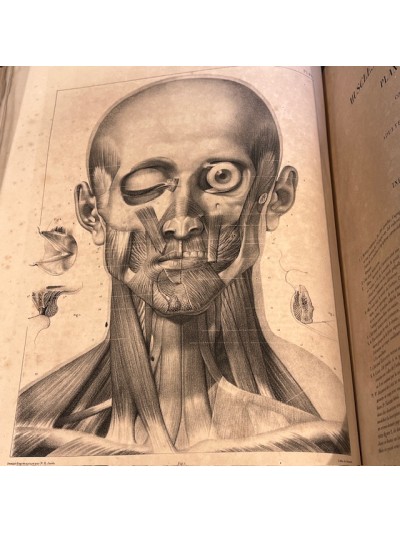
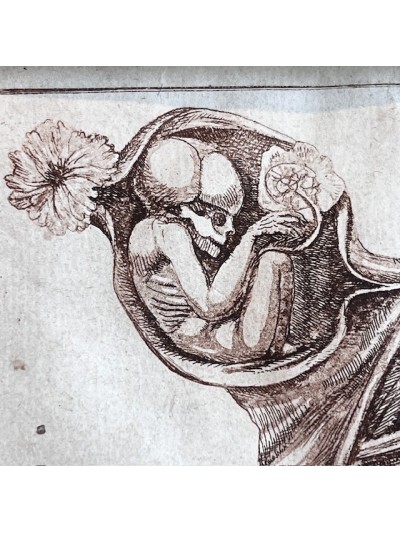
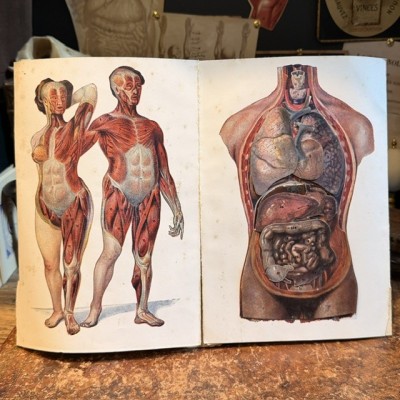
Anatomie de L'Homme - 1831
Anatomy of Man
Volume 2 with its black and white Atlas - 99 lithography
By Dr Bourgery and the illustrator Jacob
Mercury Chalk – Treatment for Syphilis
Antique amber glass bottle, with a boxwood and cork stopper.
Handwritten label, pen inscription ‘Mercurial Chalk’, neat calligraphy with its thick and thin strokes.
Bottom band ‘TO BE SEPARATED’, instructing the pharmacist to store it in the cabinet for toxic substances, the famous poison cabinet.
It comes from the former cellar-laboratory of a Parisian pharmacy. The bottles had not been moved from the shelves since the late 1950s. The cellar had served as a medical analysis laboratory and a laboratory for the pharmacy’s compounded preparations from 1900 until around 1950.
Period: Judging by the handwriting, late 19th century
EMPTY
Sparteine sulphate
Used as a tonic for nervous syndromes at the very beginning of the 20th century, sparteine was also used to facilitate morphine withdrawal.
Antique pharmacy bottle
Apothecary vial
Some product left inside
Eau de Dalibour
Antique pharmacy bottle
Beautiful handwritten labels from the period
EMPTY
Gaïacol liquide
Antique pharmacy bottle
Green label: SUBSTANCE TO BE SEPARATED - CODEX 1908
This means that this bottle had to be kept separate from the others because it was dangerous in high doses
EMPTY
Unknown bottle from Coopération Pharmaceutique Française
Antique pharmacy bottle
Apothecary vial
70° alcohol
Antique pharmacy bottle - Apothecary
Mrs Bataille-Simon, First Class Pharmacist in Beaumont sur Sarthe - Tel 9
Box of rubber washers for hot water bottles
In its original cardboard box
1939/1940
New Old Stock
Aconit leaves - POISON
Antique pharmacy bottle - Wide-mouth apothecary jar.
19th-century mouth-blown glass
Red POISON label
Signaling to the pharmacist that it is imperative to keep apart the other substances in the cabinet of toxic substances, the famous poison cabinet.
A fascinating testimony to pharmacology
It comes from an old cellar-laboratory in a Parisian pharmacy. The bottles had not moved since the late 1950s on the shelves. The cellar had served as a laboratory for medical analyses and a laboratory for magistral preparations of the pharmacy from 1900 until around 1950.
Antique Guyon bladder syringe in bakelite
Beginning of XXth century
Small antique engraved glass bell
I believe these are antique glass pieces that were originally intended to be placed on a stand.
Repurpose them as small bells to showcase your small objects, such as a small skull, as shown here.
Sold individually
EMPTY
Pyramidon
Antique pharmacy bottle
Apothecary vial
Color pigments have been added to the inside of the jar
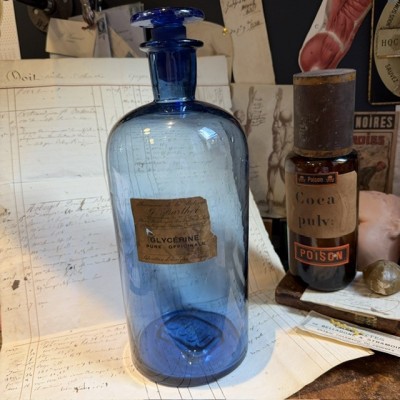
Cobalt blue glass pharmacy jar - Apothecary - Wide neck - H26cm - 19th
Apothecary jar with wide opening. Antique pharmacy bottle
Mouth-blown glass - Cobalt blue color tinted throughout
This large-capacity jar was a storage jar intended for stockpiling
Metal box of breath mints with cocaine
Box of pastilles Menthol-Borate-Cocaïne-Stovaïne from CPF Laboratories
1920's
EMPTY
Protective laboratory bell jar - Low form with knob in blown glass
Period: 1900 - Pharmacy - Apothecary
Used by the pharmacist to cover precision instruments or isolate preparations undergoing analysis