- New
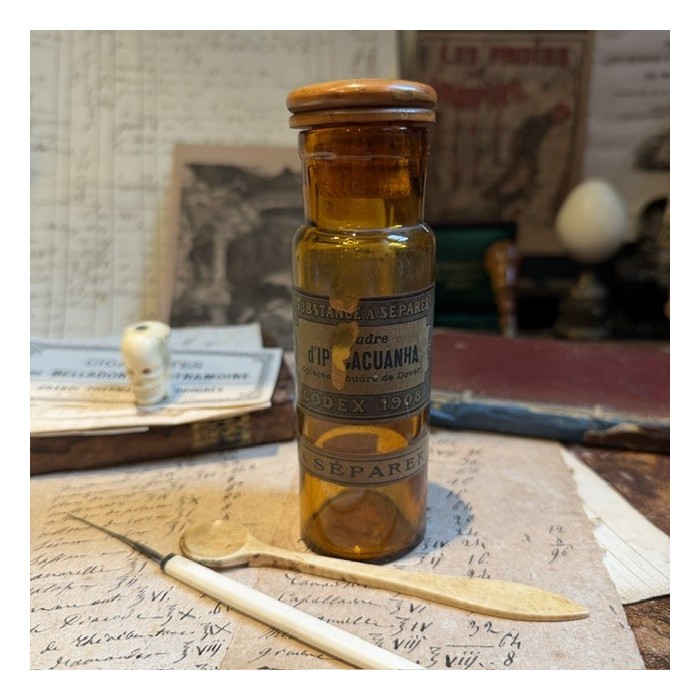
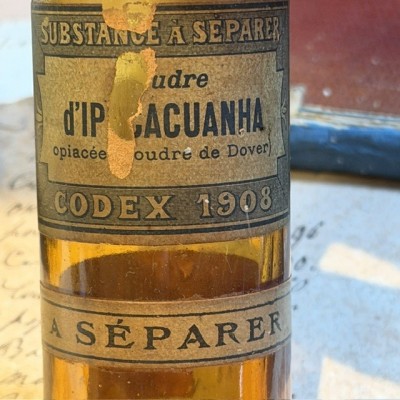
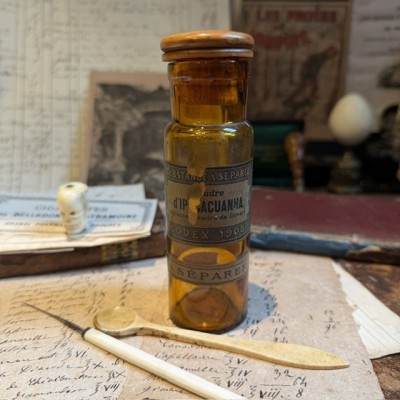
Ipecacuanha Opiate Powder - Dover's Powder
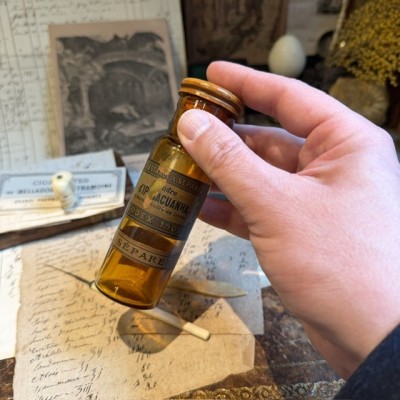
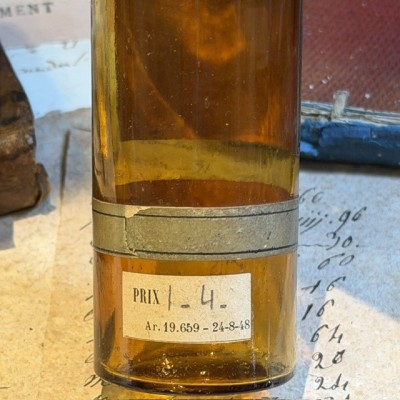
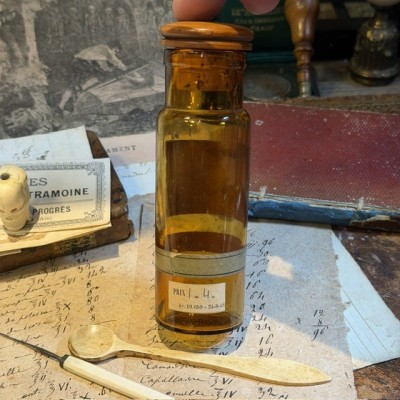
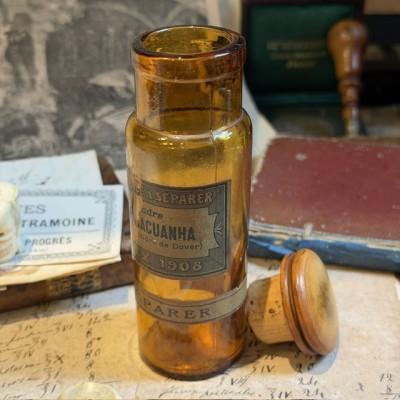
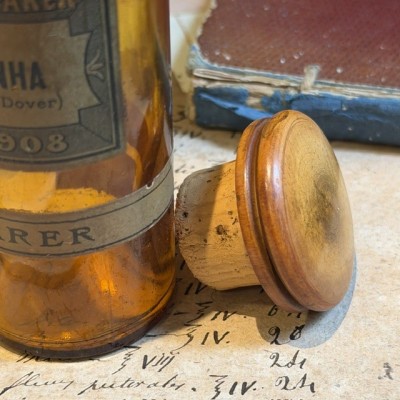
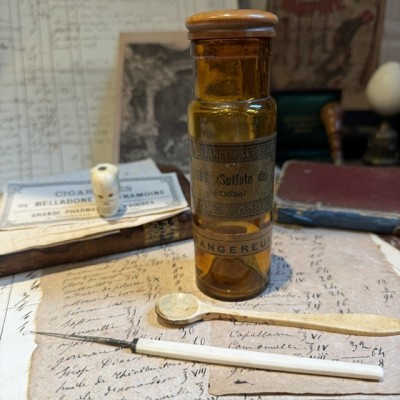
Antique amber glass bottle, with a boxwood and cork stopper.
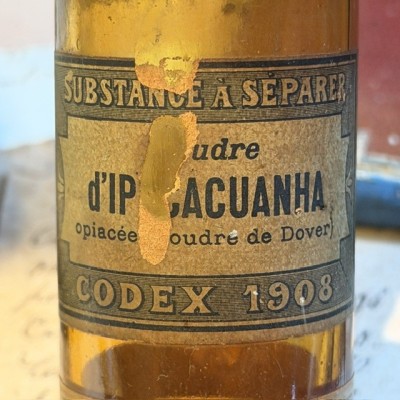
Green label: SUBSTANCE TO BE STORED SEPARATELY – CODEX 1908
Indicating to the pharmacist that it must be stored separately from other substances in the cabinet for toxic substances, the famous ‘poison cabinet’.
It comes from the former cellar-laboratory of a Parisian pharmacy. The bottles had not been moved from the shelves since the late 1950s. The cellar had served as a medical analysis laboratory and a laboratory for the pharmacy’s compounded preparations from 1900 until around 1950.
EMPTY
Ipecacuanha Opiate Powder - Dover's Powder
Antique amber glass bottle, with a boxwood and cork stopper.
Green label: SUBSTANCE TO BE STORED SEPARATELY – CODEX 1908
Indicating to the pharmacist that it must be stored separately from other substances in the cabinet for toxic substances, the famous ‘poison cabinet’.
Dover's Powder is a standardized compounded preparation whose formula remained virtually unchanged from the 18th century until it was removed from pharmacopoeias in the 20th century. It was the go-to remedy of the time for treating respiratory conditions and breaking fevers.
It is composed of:
- Ipecacuanha root, which in high doses is a powerful emetic (inducing vomiting) but in low doses is an excellent expectorant that thins bronchial secretions.
- And it also contains opium, which provides sedative, analgesic (pain-relieving), and, above all, antitussive (cough-suppressing) properties.
Due to its opium content, this powder fell directly into the category of poisonous substances that could not be left freely accessible or mixed with simple powders to prevent any fatal dosing errors.
It comes from the former cellar-laboratory of a Parisian pharmacy. The bottles had not been moved from the shelves since the late 1950s. The cellar had served as a medical analysis laboratory and a laboratory for the pharmacy’s compounded preparations from 1900 until around 1950.
Height of the bottle: 12cm with stopper
EMPTY

Antique brown glass bottle with integrated pipette - Ref B
Apothecary - Pharmacy
The pipettes have either been broken or shortened because they are too short
Antique pharmacy jar: Lignum Quillayae Saponaria - Panama wood - 19th century
Antique medicine box in canvas cardboard
Size L
EMPTY
Infangyl Carlier
Antique pharmacy bottle - Apothecary
The box still contains its full, sealed bottle and instructions
Antique pharmacy bottle
BIOLACTYL Ferment Fournier - Early 1900
Eau de Cologne du Mont St Michel
Antique BLUE glass pharmacy bottle
EMPTY
19th century Herbalist's or Pharmacy crystal jar
Iris
An antique absinthe topette (decanter)
10 Beaded Topette
Horseradish syrup
Grams / Tablespoons - Graduated bottle
in French: Grammes / Cuillères à soupe
Antique medicine bottle
Apothecary
Antique 19th century pharmacy bottle
Radix althaeae Off - Marshmallow
Drops No. 234,625
Antique pharmacy bottle
EMPTY
Dextrin powder - Starch - Pulvis Dextrinae
Antique pharmacy bottle
Blown glass
Lower part of the lower mandible of a horse jaw
Antique model from Maison Auzoux in Paris
Paper-mâché pedagogical model
Model A - 9 months
An antique absinthe topette (decanter)
6 Beaded Topette
Residue in the bottom of the carafe
Silver Nitrate Sticks
Antique amber glass bottle, with a boxwood and cork stopper.
Green label: SUBSTANCE TO BE STORED SEPARATELY – CODEX 1908
Indicating to the pharmacist that it must be stored separately from other substances in the cabinet for toxic substances, the famous ‘poison cabinet’.
It comes from the former cellar-laboratory of a Parisian pharmacy. The bottles had not been moved from the shelves since the late 1950s. The cellar had served as a medical analysis laboratory and a laboratory for the pharmacy’s compounded preparations from 1900 until around 1950.
EMPTY
Ipecacuanha Opiate Powder - Dover's Powder
Antique amber glass bottle, with a boxwood and cork stopper.
Green label: SUBSTANCE TO BE STORED SEPARATELY – CODEX 1908
Indicating to the pharmacist that it must be stored separately from other substances in the cabinet for toxic substances, the famous ‘poison cabinet’.
It comes from the former cellar-laboratory of a Parisian pharmacy. The bottles had not been moved from the shelves since the late 1950s. The cellar had served as a medical analysis laboratory and a laboratory for the pharmacy’s compounded preparations from 1900 until around 1950.
EMPTY