
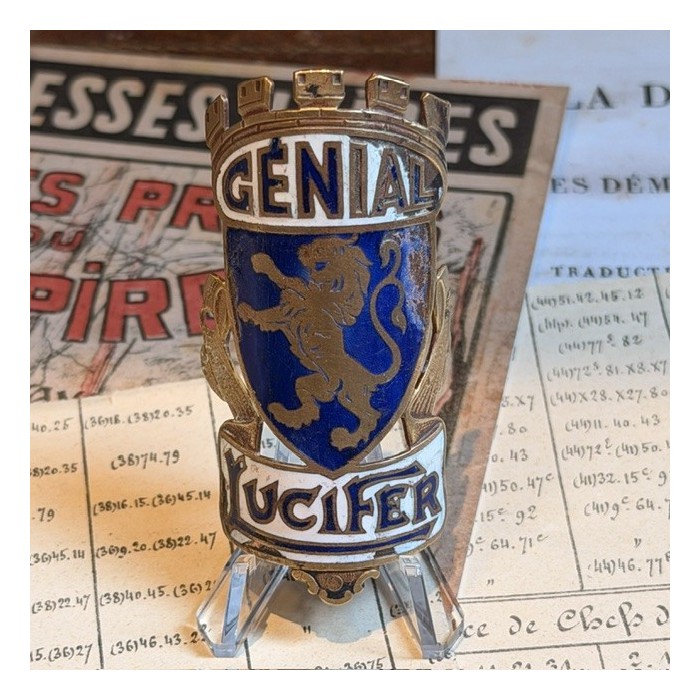
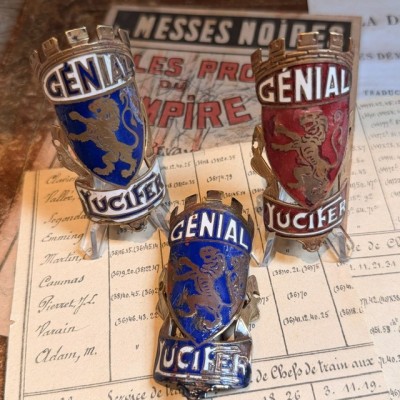
"Génial Lucifer"- Vintage bicycle headbadge
Brass & Blue Enamel to be placed on the bicycle tube at the front
The 1930s
Génial Lucifer
Vintage bicycle headbadge - 1930
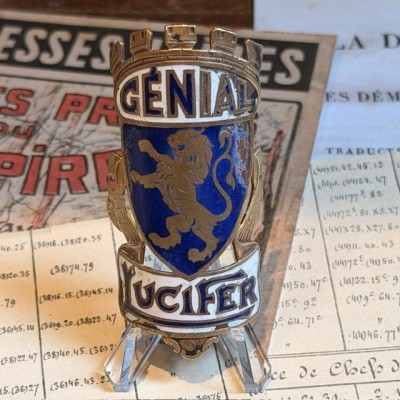
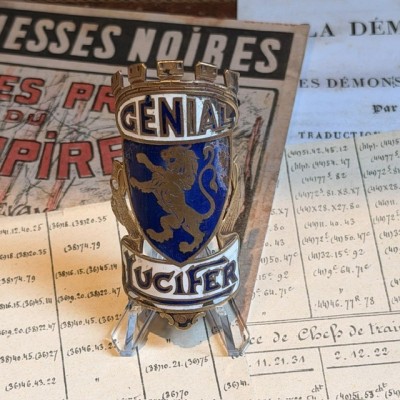
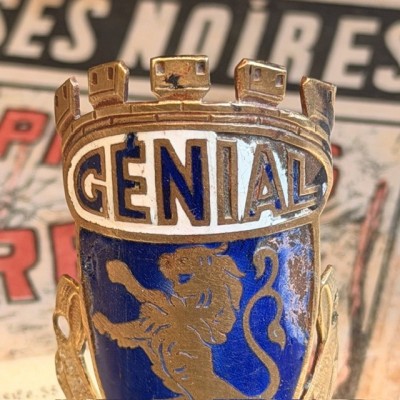
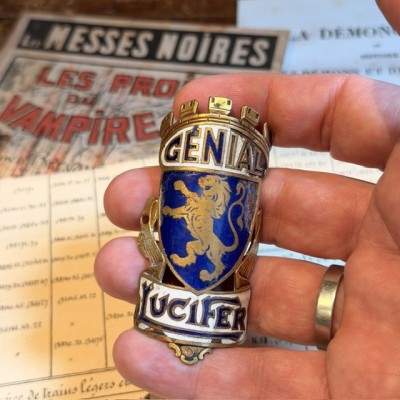
Period piece in brass characterized by its upper cut-out in crenellated crown.
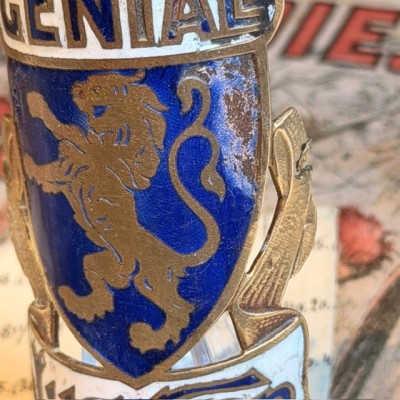
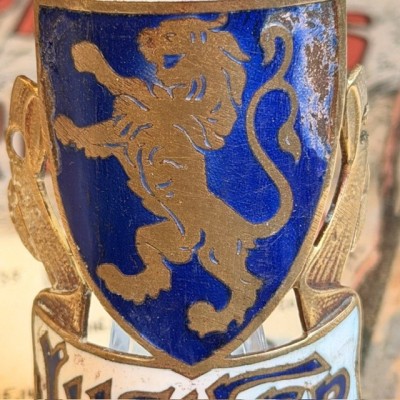
The heart of the coat of arms, enhanced with a deep blue enamel, bears the emblem of the brand: an imp.
Not to be confused with a lion!
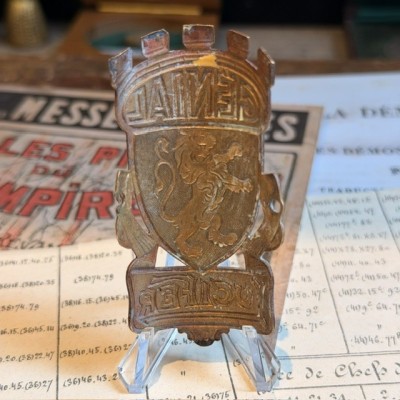
The reliefs at the back of the plate better reveal the characteristic details of the devil: a head topped with small horns and the clearly forked tail (bifid) engraved in the matrix.
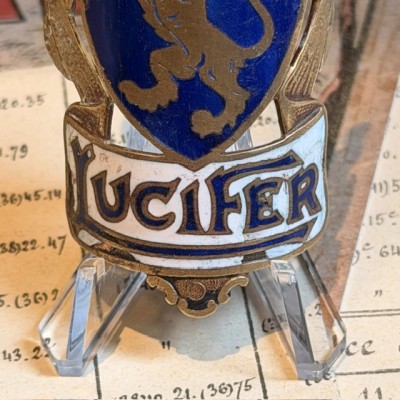
The lettering "GÉNIAL" and "LUCIFER" frame the embossed coat of arms on a white enamel background.
Blue and white enamel paint on a curved brass plate to fit on the frame of a bicycle.
Date from the 1930s with a very beautiful typography.
Why a name like that for a bike?
This plate bears witness to a major industrial alliance between the two world wars. It was born from the merger, in 1930, between the establishments Génial (a famous Lyon manufacturer of frames founded in 1907 by Louis Mouterde) and the Parisian brand of cycles Lucifer. The latter was created in 1902 by the supply house Mestre & Blatgé, located on avenue de la Grande-Armée in Paris.
The name Lucifer originally played on its Latin etymology Lux Fero, the bearer of light, evoking the progress of the time, but the company chose to illustrate it in a heraldic way by an imp.
This gave society Génial Lucifer!
During its golden age (from the 1930s to the 1950s), Génial-Lucifer will shine at the top of French cycling by equipping great champions of the Tour de France such as Charles Pélissier or Jean Robic, before ceasing production in 1956
Material: Brass, blue and white enamel.
Dimensions: Height: 7cm - Maximum width: about 3cm
Condition: Authentic vintage. Natural oxidation and patina of time, enamel with cracks or minor gaps that highlight its history. The lateral attachment eyelets are intact.
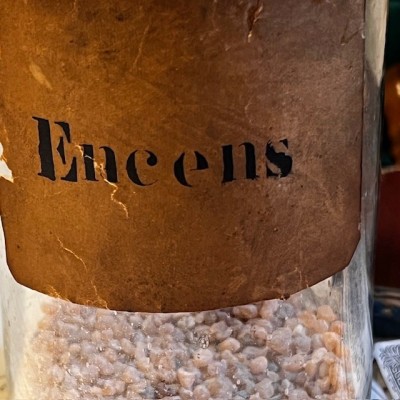
Incense
Antique pharmacy bottle - Wide-mouth apothecary jar.
19th-century mouth-blown glass
There are still some product inside.
A fascinating artifact from the history of pharmacology
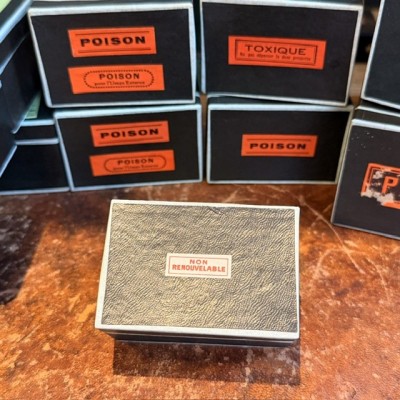
Antique labels in a pharmacy box for cures made of canvas cardboard
Non-renewable label
The pharmacist used his boxes of medicine to put away the labels he would then put on the bottles that he would resell to his customers.
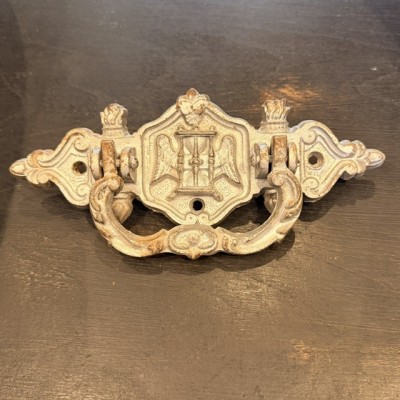
Coffin handle - Winged hourglass
around 1900
You buy only 1 handle
Traces of oxidation on the handles, more or less important
Brand new from the period, it has never been used.
Aqua Calris - Hot water
Antique pharmacy jar
Apothecary
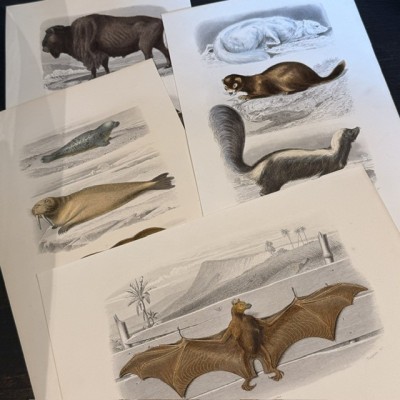
Natural History Board of Buffon - Éditions Garnier Frères
Around 1853/1857
Animals - Zoology
Board size: 26.5x17.5cm (Grand In-8)
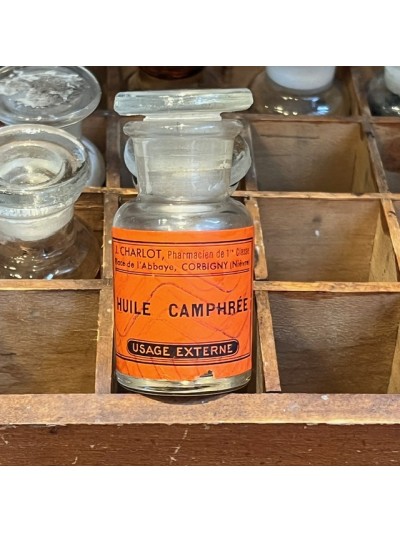
Camphorated oil
Antique pharmacy bottle
Apothecary vial
EMPTY but cap is blocked and bottle will not open
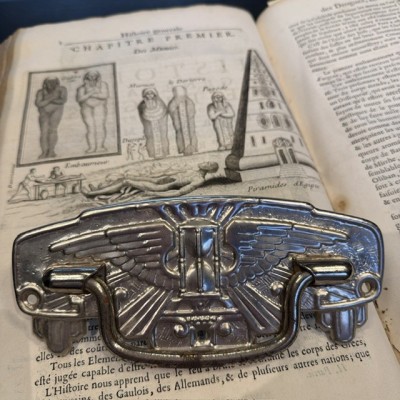
Antique Chrome-plated metal coffin handle
Winged hourglass motif
Art Deco period – 1925–1935
Some signs of oxidation on the handles
Brand new from the period; it has never been installed
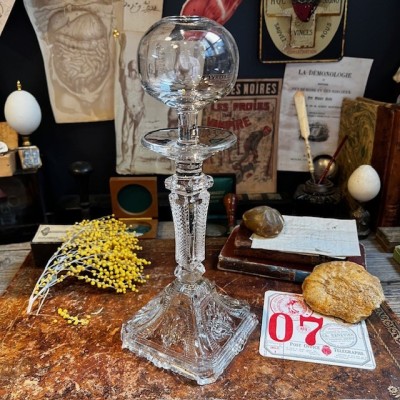
Antique glass oil lamp in pressed molded glass - Provence
19th century, circa 1880/1890
Decorated with satyr masks, ram's head and bouquet of flowers
Height 26cm
Highly transparent crystal glass with beautiful clarity
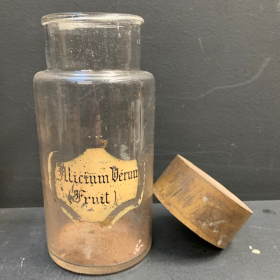
Antique pharmacy jar: Illicium verum (Fruit) / Star anise
Glass pharmacy bottle - XIXth century
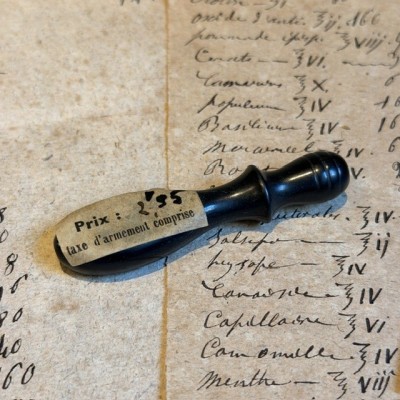
Ebonite cannula tip
Tips for enema or medical irrigation cannulas. New Old Stock
Marketed between May 1939 and sometime in 1940
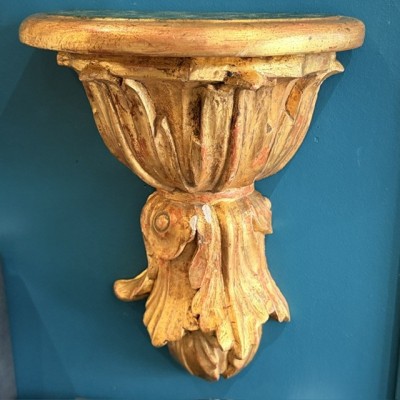
Cul-de-lampe Wall Bracket Console - Stuccoed and Gilded Wood - Italy (Tuscany), 19th Century
Early 19th-century wall console
Gilded wood and stucco with painted faux antique green marble
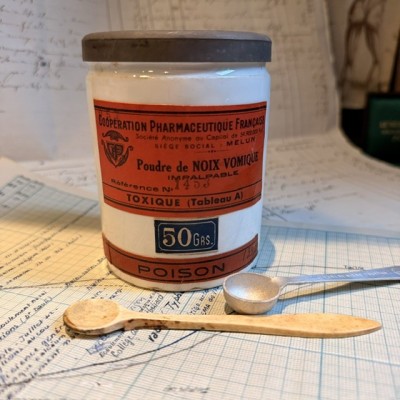
Impalpable Nux Vomica powder
White earthenware pot
Red POISON and TOXIC label
Signaling to the pharmacist that it is imperative to keep apart the other substances in the cabinet of toxic substances, the famous poison cabinet.
It comes from an old cellar-laboratory in a Parisian pharmacy. The bottles had not moved since the late 1950s on the shelves. The cellar had served as a laboratory for medical analyses and a laboratory for magistral preparations of the pharmacy from 1900 until around 1950.
EMPTY
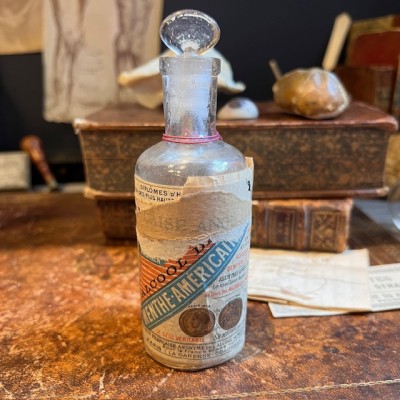
American mint alcohol
Antique pharmacy bottle
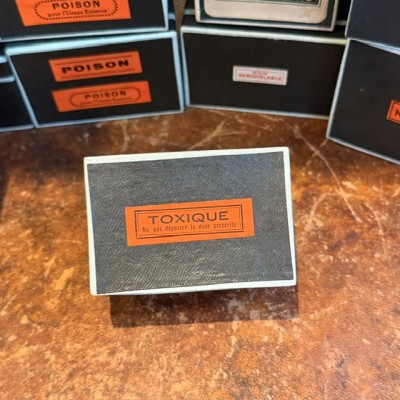
Antique labels in a pharmacy box for cures made of canvas cardboard
TOXIC label - Do not exceed the prescribed dose
The pharmacist used his boxes of medicine to put away the labels he would then put on the bottles that he would resell to his customers.
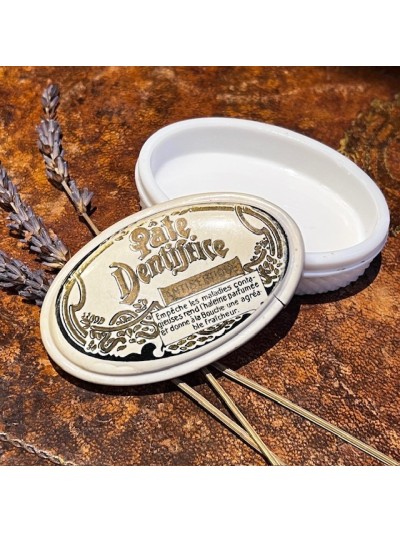
Toothpaste - Antique apothecary
Porcelain pot with illustrated plastic lid
Antiseptic
Early 20th century - Caution the lid is cracked
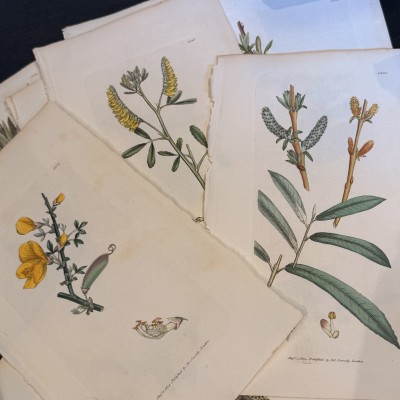
Botanical Plank - English Botany
Published in 1804
Original copper engraving, enhanced with a hand-made watercolor coloration
Painted watercolor engraving from the 19th century
"Génial Lucifer"- Vintage bicycle headbadge
Brass & Blue Enamel to be placed on the bicycle tube at the front
The 1930s