
- New
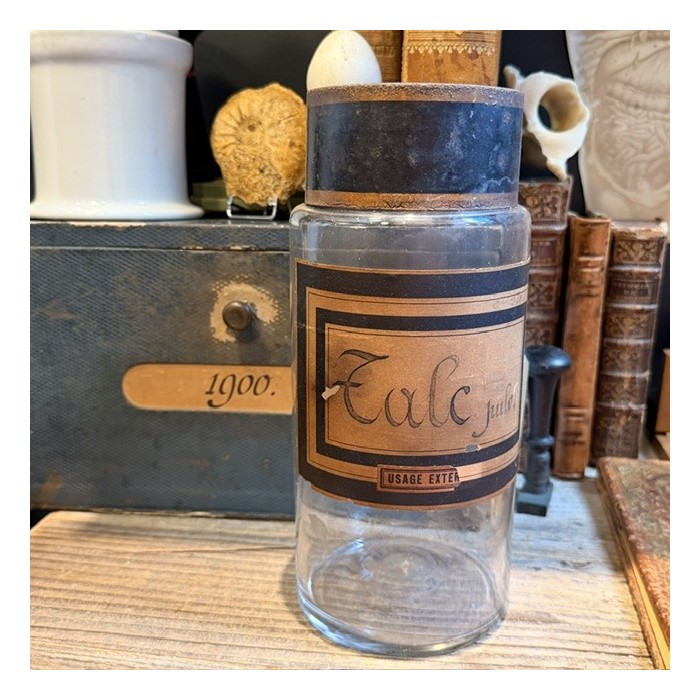
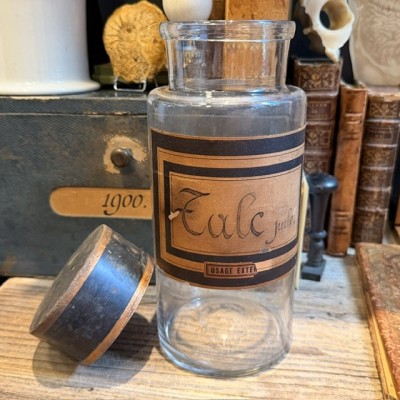
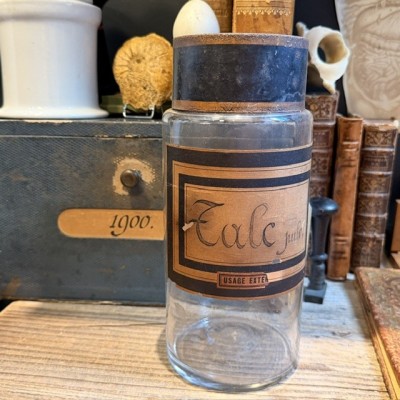
Talc powder
Pharmacy jar - Herbalism - Apothecary Mouth-blown glass bottle
Late 19th century - Beginning of the 20th
Talc powder
Pharmacy jar - Herbalism - Apothecary bottle
Late 19th century - Beginning of the 20th
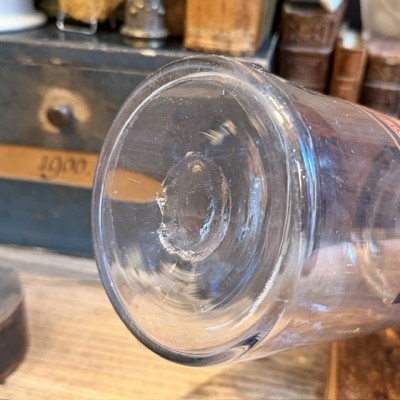
Mouth-blown glass, as the depression of the cane's pontil remains under the jar.
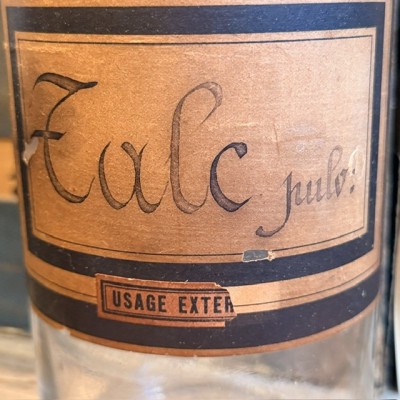
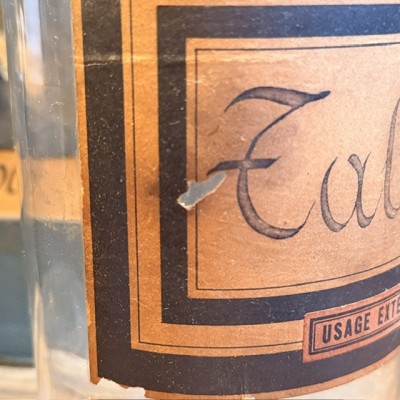
Original label made of black-framed paper, with the handwritten inscription in ink "Talc pulv." (for Talcum pulverisatum / Talc powder). A small secondary label affixed to the bottom specifies the precautionary statement "EXTERNAL USE."
In powder form, powdered talc was widely used in pharmacies to absorb moisture, soothe skin irritations or serve as an excipient for making pills and powders.
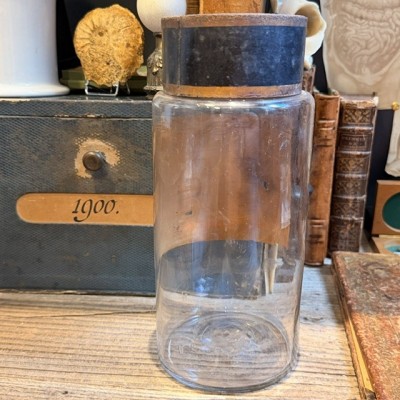
Tin stopper.
It comes from an old cellar-laboratory in a Parisian pharmacy. The bottles had not moved since the late 1950s on the shelves. The cellar had served as a laboratory for medical analyses and a laboratory for magistral preparations of the pharmacy from 1900 until around 1950.
This large-capacity jar was a reserve jar intended for the storage of raw materials to be processed into powders, tinctures or infusions in the pharmacy laboratory.
Diameter 10cm. Height with cap 24cm
SOLD EMPTY
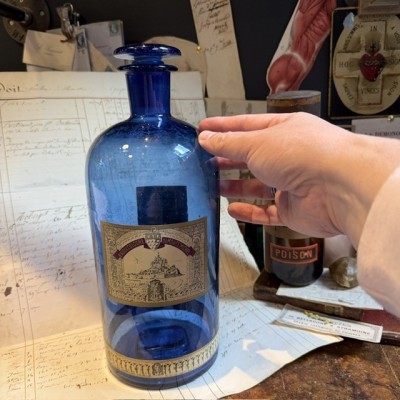
Eau de Cologne du Mont St Michel
Antique BLUE glass pharmacy bottle
EMPTY
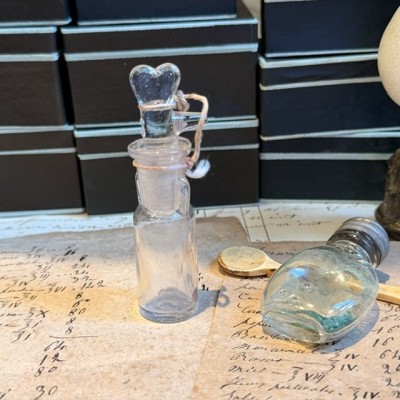
Dropper bottle
Antique pharmacy bottle - 1920-30's
Glass stopper honed in the shape of a heart for better grip
EMPTY
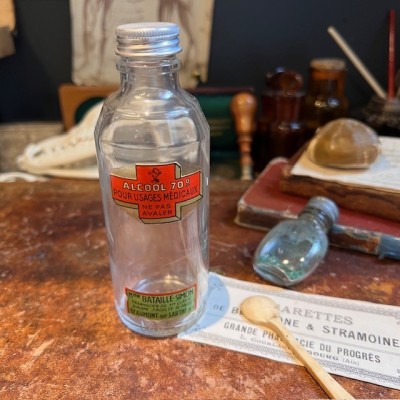
70° alcohol
Antique pharmacy bottle - Apothecary
Mrs Bataille-Simon, First Class Pharmacist in Beaumont sur Sarthe - Tel 9
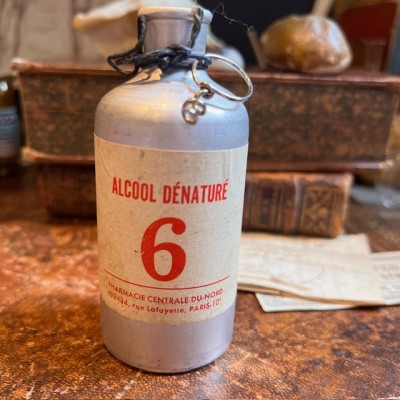
Alcool dénaturé - Alcool à brûler
Denatured alcohol - Methylated spirits
Antique pharmacy bottle - Apothecary
Empty
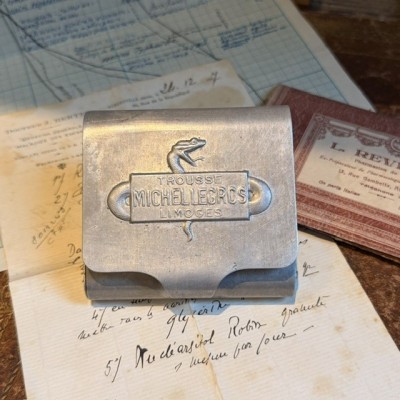
Antique First aid kit for the healing of snake bites
Glass syringe and 2 vintage doses of vaccine
Vintage quack remedy!
Beautiful snake illustration on the aluminium box
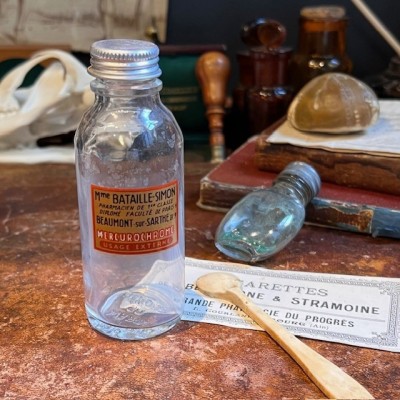
Mercurochrome
Antique pharmacy bottle - Apothecary
Mrs Bataille-Simon, First Class Pharmacist in Beaumont sur Sarthe - Tel 9
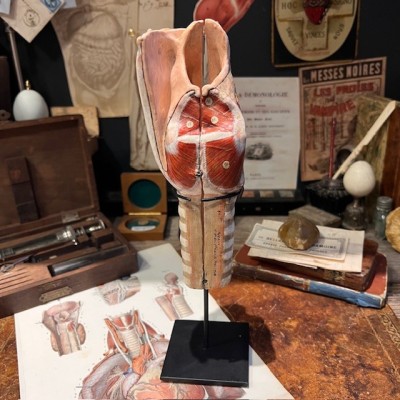
Antique anatomical model of the larynx and trachea made of painted papier-mâché.
Produced by Établissements Auzoux and manually dated 1938.
Model can be dismantled lengthwise, numbered, used for medical teaching.
Please note: one removable side piece is missing. The model remains stable and highly decorative. Authentic piece.
Handwritten inscription from the period: Larynx - Auzoux à St-Aubin-d’Écrosville Eure 1938
Placed in a metal base, it can be easily removed to hold it in your hand.
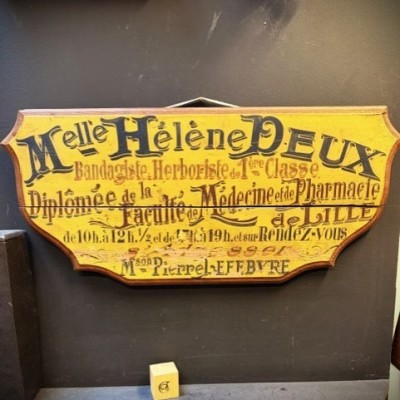
Rare and authentic wall sign panel
Pharmacy and fitting brand - Miss Hélène Deux, Bandagiste & 1st class Herbalist
Officine sign panel in painted wood from the 19th-20th century hinge: 1890-1920.
The sign is made of 2 reinforced wood panels at the back. There is a space between the 2 panels.
The sign features a superb art lettering entirely made freehand by a letter painter (superb contrasts of blue and brown, neat full and loose)
Witness to the history of pharmacy and ancient orthopaedics: the bandagist shaping leather and frames for corsets and restraints, and the herbalist 1st class, a profession that has disappeared since the abolition of the diploma in 1941.
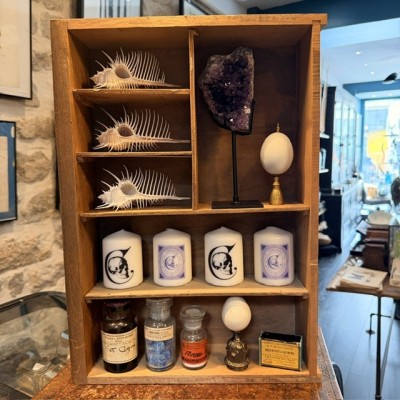
Large antique wooden pharmacy drawer with compartments
6 compartments
Curiosity shelf
Ref C - 48x34.5cm - Thickness 9.5cm
Can be used as a presentation furniture
SOLD EMPTY WITHOUT ACCESSORIES
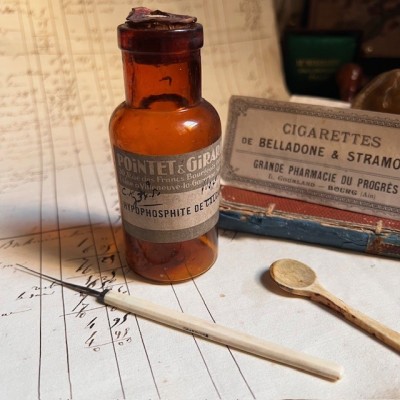
Hypophosphite de Calcium
Antique pharmacy bottle
EMPTY
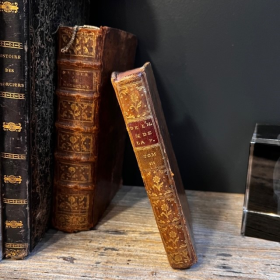
De l'Homme et de la Femme (Of Man and Woman)
By M. de Lignac - Volume 3
Anatomy of procreation - 1779
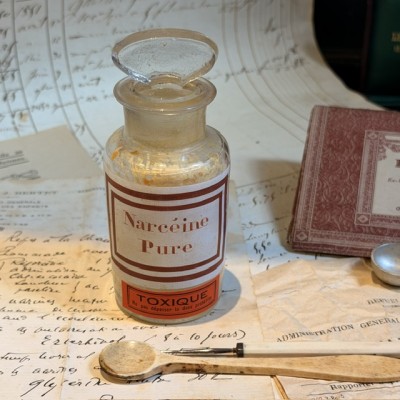
Narceine - Opium Derivative
Antique pharmacy bottle made of blown glass and enameled painted label.
Red TOXIC label
Signaling to the pharmacist that it is imperative to keep apart the other substances in the cabinet of toxic substances, the famous poison cabinet.
Dating: 19th century
EMPTY - The bottle is blocked and does not open, sealed by time
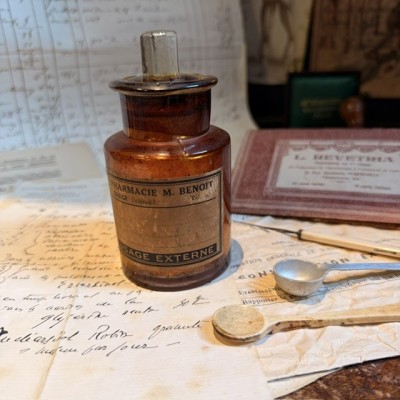
M. BENOIT Pharmacy
Antique pharmacy bottle
EMPTY - Blocked cap
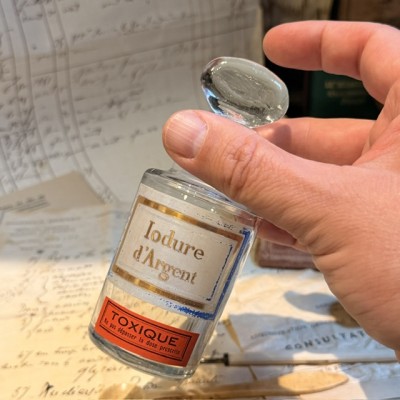
Silver iodide
Antique pharmacy bottle made of blown glass and enameled painted label with golden blue threads
Red TOXIC label
Signaling to the pharmacist that it is imperative to keep apart the other substances in the cabinet of toxic substances, the famous poison cabinet.
Dating: 19th century
EMPTY
Unknown bottle from Coopération Pharmaceutique Française
Antique pharmacy bottle
Apothecary vial
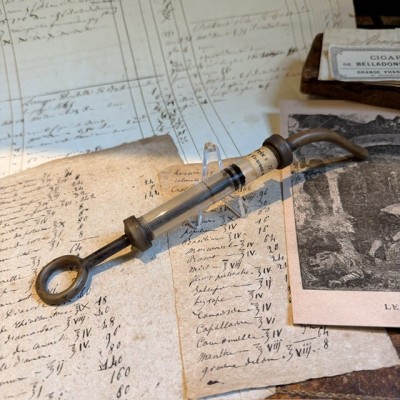
Ebonite and glass laryngeal syringe
For intra-laryngeal injections.
Marketed between May 1939 and sometime in 1940
Talc powder
Pharmacy jar - Herbalism - Apothecary Mouth-blown glass bottle
Late 19th century - Beginning of the 20th