

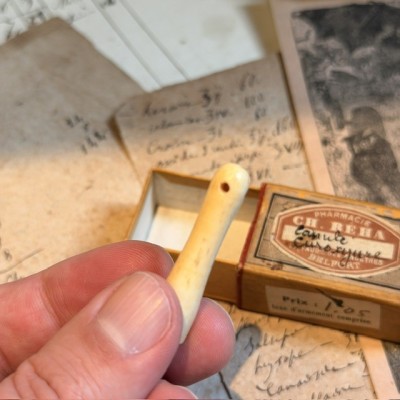
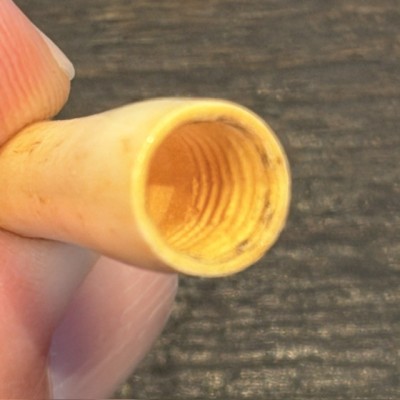
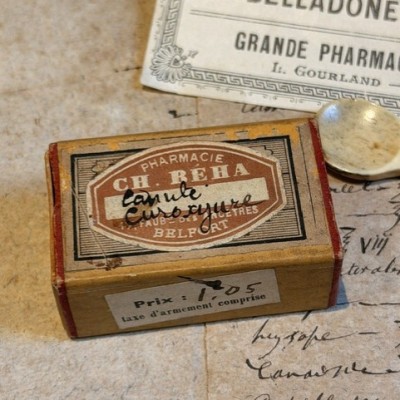
Polished bone cannula - New vintage stock - In its reusable box
Vintage medical device designed to remove pinworms
Marketed between May 1939 and sometime in 1940
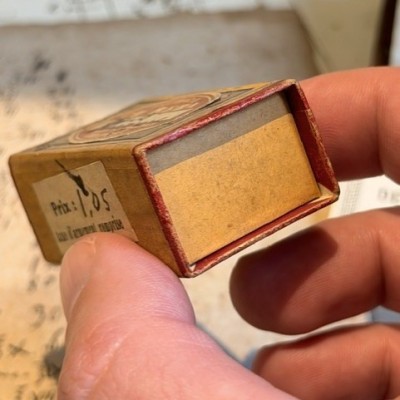
Polished bone cannula – New vintage stock – In its original box
A vintage medical device designed to remove intestinal worms , a very common type of small intestinal parasite.
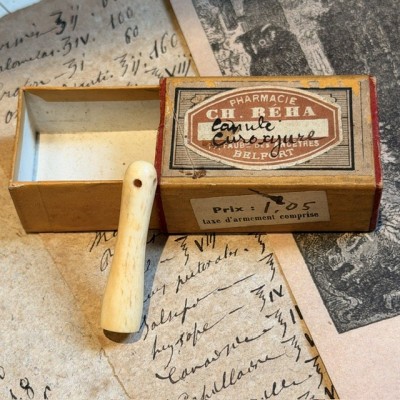
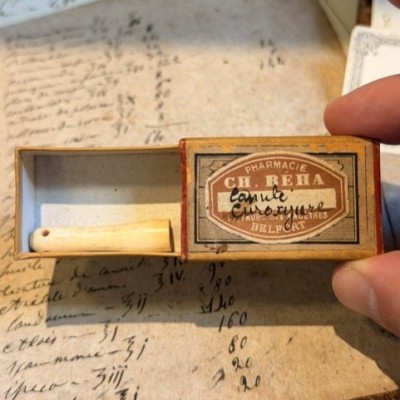
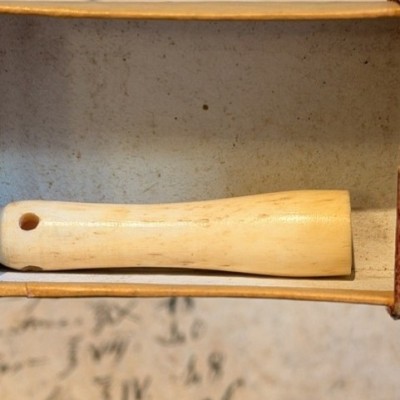
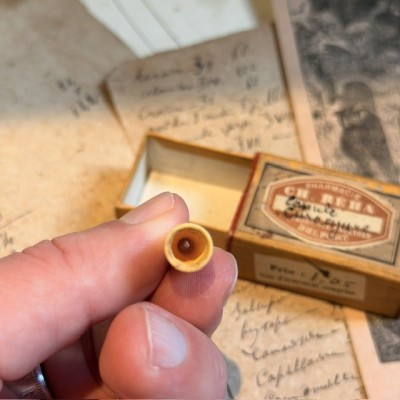
This small cannula was screwed onto the end of a rubber bulb or an injection syringe. It was used to administer purgative or vermifuge enemas locally.
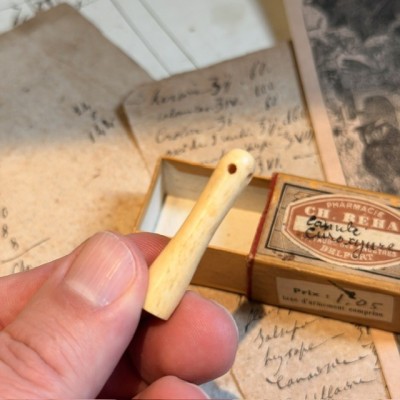
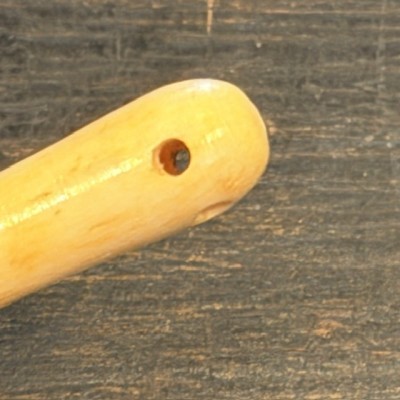
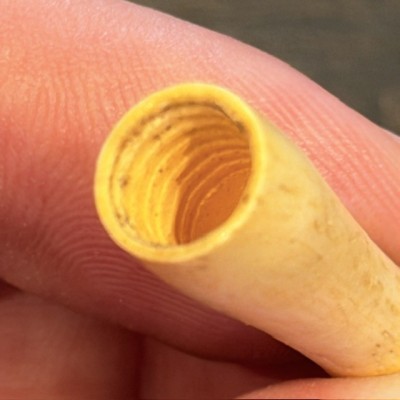
Carefully crafted: the upper end features a lateral diffusion eyelet, whilst the base has a clean internal thread, turned by a lathe operator, to screw perfectly onto the rubber bulbs of the period.
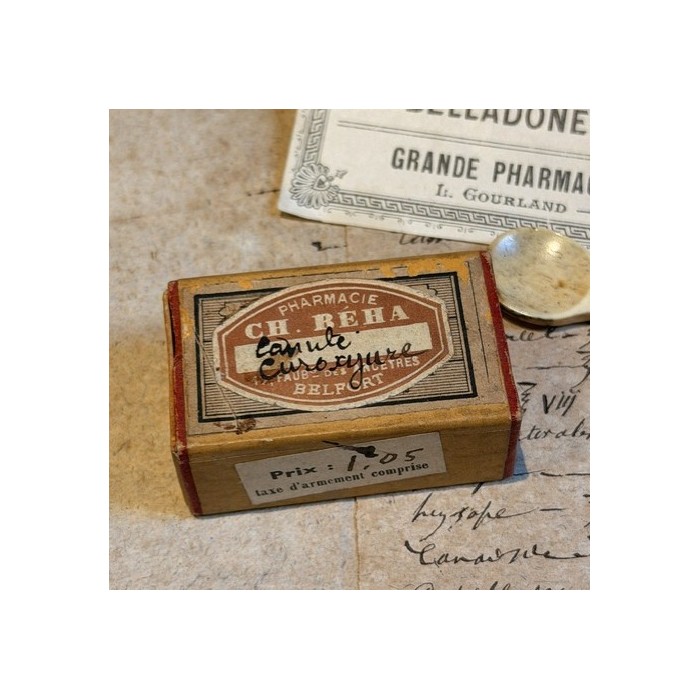
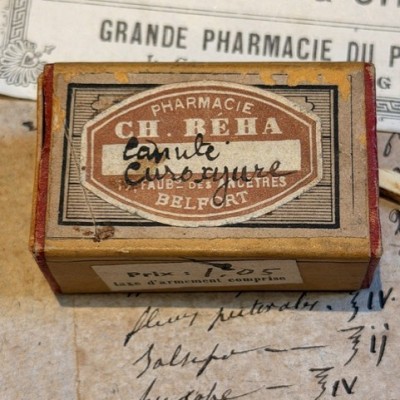
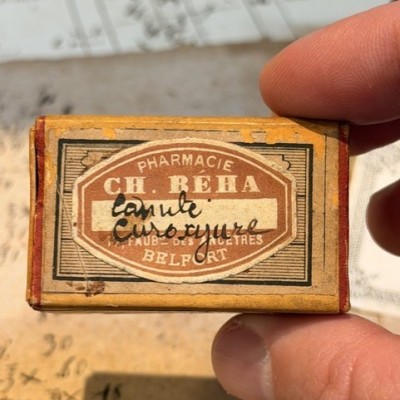
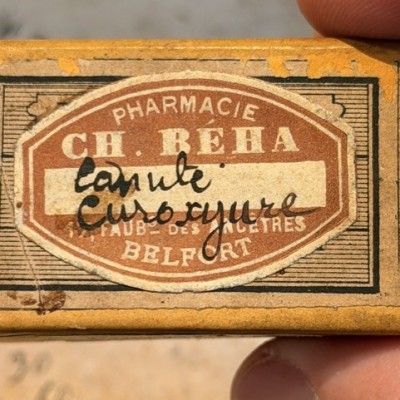
A sign of the pharmacist’s pragmatism and the early days of wartime restrictions, this box is a pure product of pharmacy recycling.
Indeed, the label from the Ch. Réha Pharmacy (17, Faubourg des Ancêtres, Belfort) has been cut out and hand-pasted onto an older label.
The lid bears the handwritten inscription in black ink from the period: ‘Canule Curoxyure’.
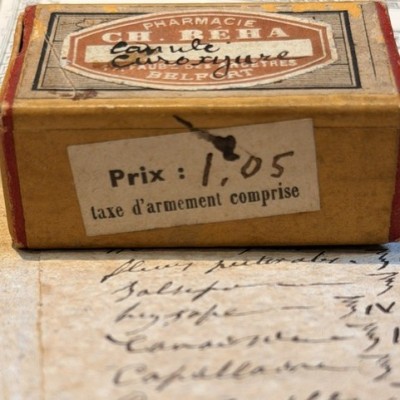
It still has its original price label stuck to the side of the box, stating ‘armament tax included’.
This inscription serves as a chronological marker: the armament tax was introduced in France by the decree-law of 21 April 1939 to finance the nation’s rearmament and was abolished in 1940 at the start of the Occupation. This cannula was therefore sold between May 1939 and sometime in 1940.
It comes from the former cellar-laboratory of a Parisian pharmacy. The bottles and other items had not been moved from the shelves since the late 1950s. The cellar had served as a medical analysis laboratory and a laboratory for the pharmacy’s compounded preparations from 1900 until around 1950.
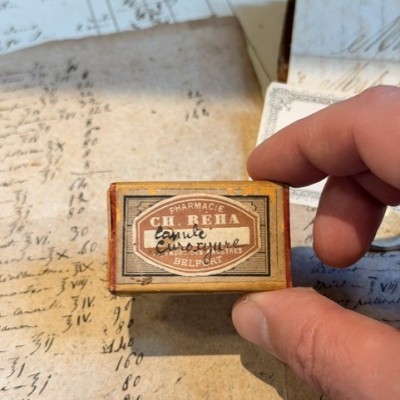
Dimensions of the box: 5x3cm
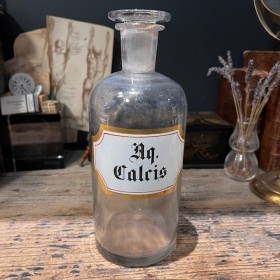
Aqua Calris - Hot water
Antique pharmacy jar
Apothecary
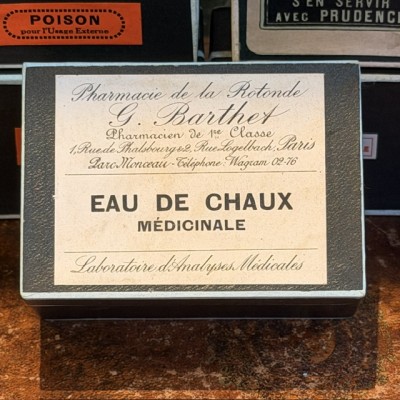
Antique labels in a pharmacy box for cures made of canvas cardboard
Label: Eau de Chaux Médicinale
The pharmacist used his boxes of medicine to put away the labels he would then put on the bottles that he would resell to his customers.
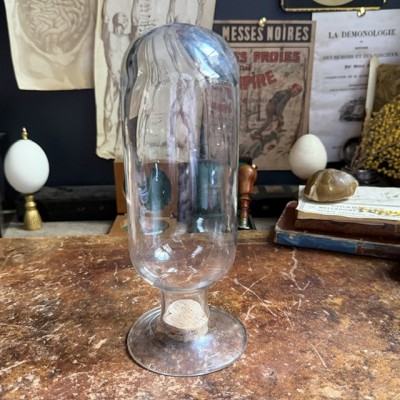
Specimen jar in blown glass – Inverted apothecary jar - Seed vase
Size M
A vintage laboratory or conservatory container designed for the display and preservation of biological or botanical specimens
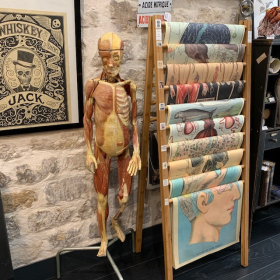
Clastic Mannequin - Dr. Auzoux's anatomical skinned
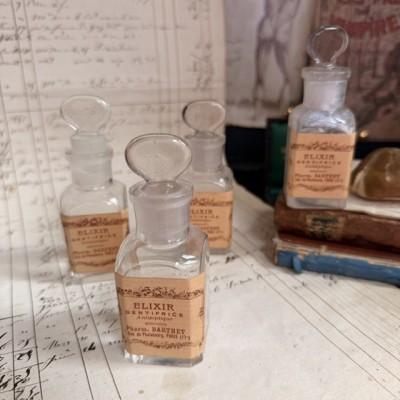
Toothpaste elixir
Antique pharmacy bottle
EMPTY
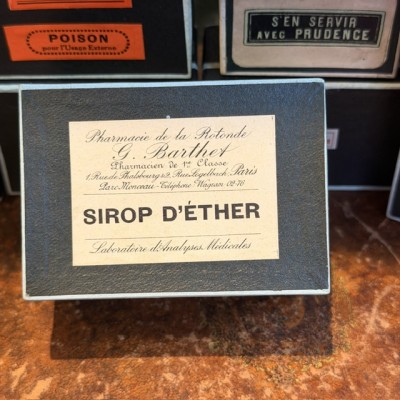
Antique labels in a pharmacy box for cures made of canvas cardboard
Label: Sirop d'Ether
The pharmacist used his boxes of medicine to put away the labels he would then put on the bottles that he would resell to his customers.
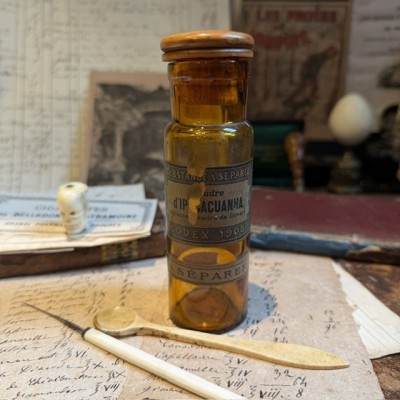
Ipecacuanha Opiate Powder - Dover's Powder
Antique amber glass bottle, with a boxwood and cork stopper.
Green label: SUBSTANCE TO BE STORED SEPARATELY – CODEX 1908
Indicating to the pharmacist that it must be stored separately from other substances in the cabinet for toxic substances, the famous ‘poison cabinet’.
It comes from the former cellar-laboratory of a Parisian pharmacy. The bottles had not been moved from the shelves since the late 1950s. The cellar had served as a medical analysis laboratory and a laboratory for the pharmacy’s compounded preparations from 1900 until around 1950.
EMPTY
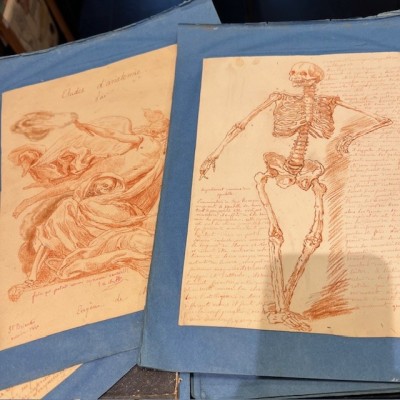
Red chalk drawing- Anatomical drawing
Anatomical study
Drawn by Eugène de Montchoisy in Saint-Brieuc in November 1840
These are not reproductions but original period drawings in red chalk.
You are purchasing one plate, not the entire set of plates
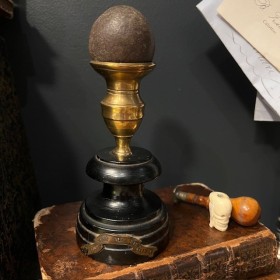
Antique bezoar - Antipoison - Antidote
Once sold by the apothecary, bezoar, also known as gallstone, was reputed to have the same anti-poison properties as the legendary unicorn's horn, hence its excessively high price, also due to its great rarity.
An important piece in a cabinet of curiosities
Sold alone - Without stand, sold separately
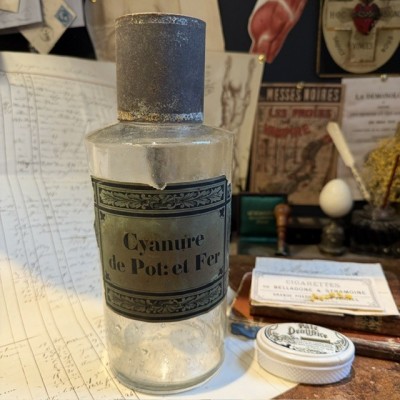
Potassium Cyanide and Iron
Also known as yellow potassium prussiate
Antique 19th-century pharmacy bottle
EMPTY

Grams / Tablespoons - Graduated bottle
in French: Grammes / Cuillères à soupe
Antique medicine bottle
Apothecary
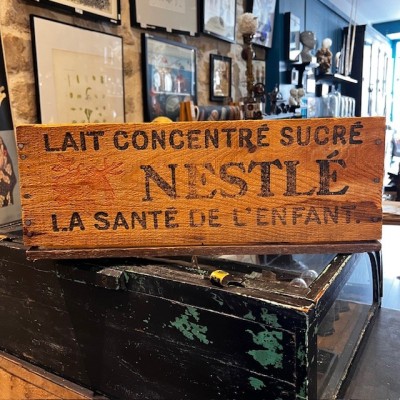
Antique wooden advertising case for Nestlé concentrated infant milk
Found in Parisian cellars that served as laboratories and storage rooms for pharmacists preparing their masterful concoctions from 1900 to 1950.
It was used to store products, glass bottles, etc.
Period: Circa 1910–1930
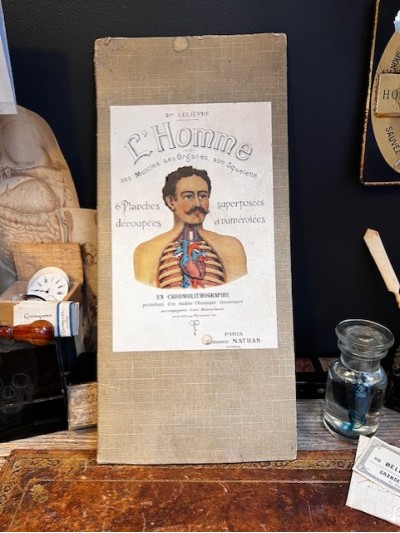
Man - Anatomical chart that can be disassembled
By Fernand Nathan Editeur publisher
Coloured chart with movable, cut-out and superimposed leaves
There are defects on the superimposed boards; the outer board, which was the man's torso, is missing, as are the lungs, which were above the heart. The left hand is missing, the arm being torn.
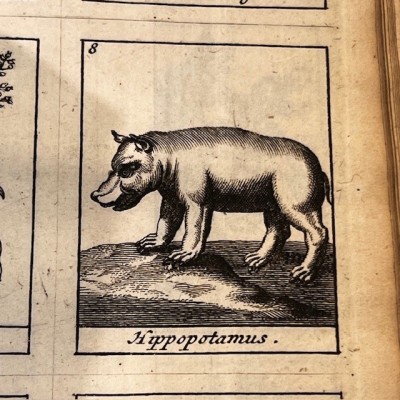
Dictionnaire Universel des Drogues Simples
Universal dictionnary of Simple Drugs
By Nicolas Lemery
An antique illustrated pharmacopoeia from 1727 - A Dutch pirated edition
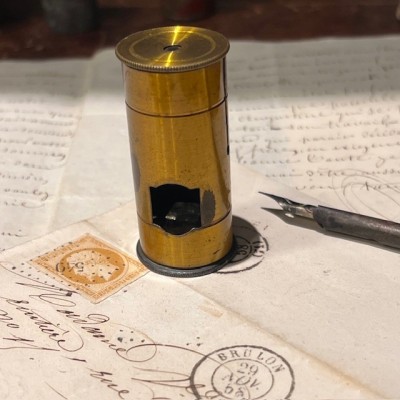
Floroscope
Botanist's microscope
Pocket microscope Late 19th - early 20th century
Warning: Here composed of 2 Stanhope lenses
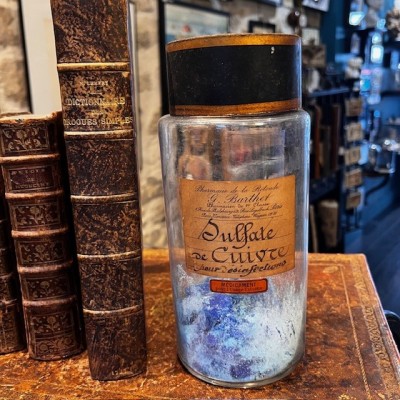
Copper Sulfate
Antique pharmacy bottle - Wide-mouth apothecary jar.
19th-century mouth-blown glass
There are still some beautiful blue crystals inside.
A fascinating artifact from the history of pharmacology
Polished bone cannula - New vintage stock - In its reusable box
Vintage medical device designed to remove pinworms
Marketed between May 1939 and sometime in 1940