

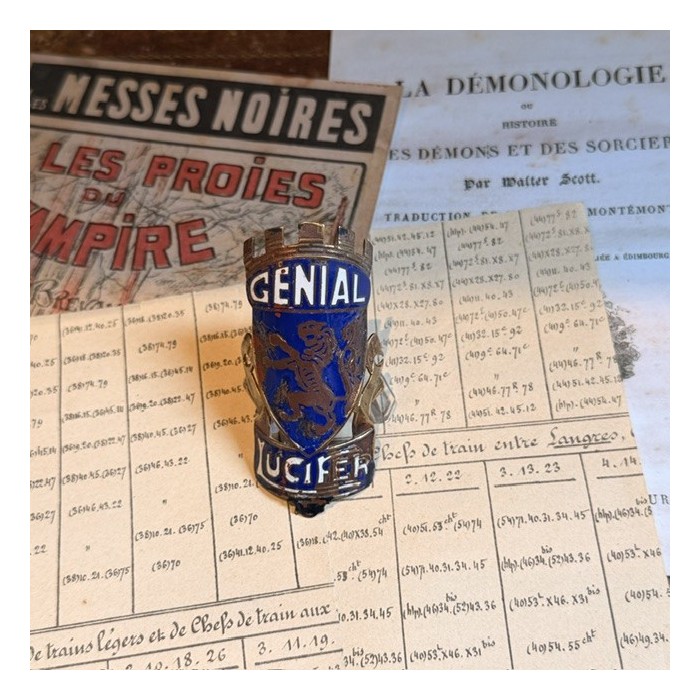
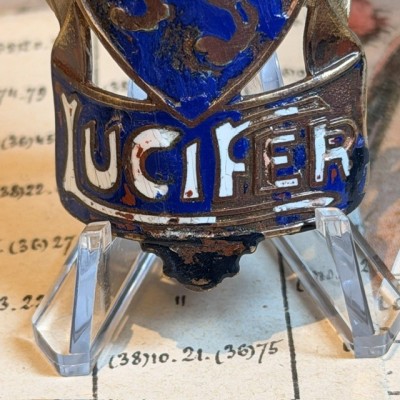
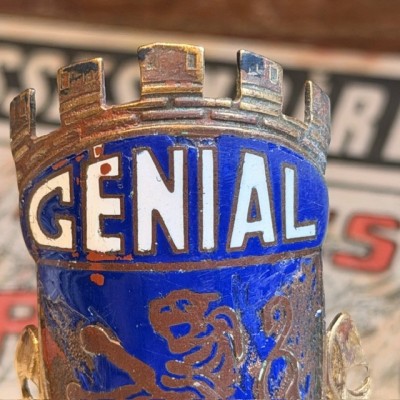
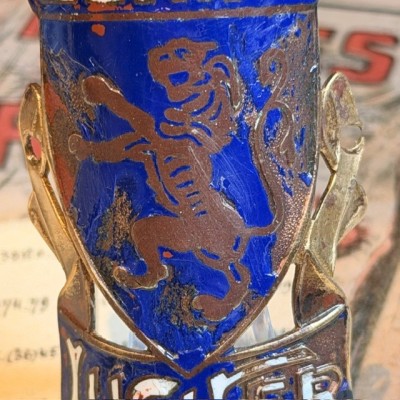
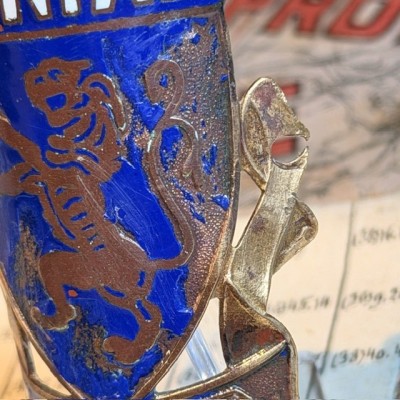
"Génial Lucifer"- Vintage bicycle headbadge
Brass & Blue Enamel to be placed on the bicycle tube at the front
The 1930s
Génial Lucifer
Vintage bicycle headbadge - 1930
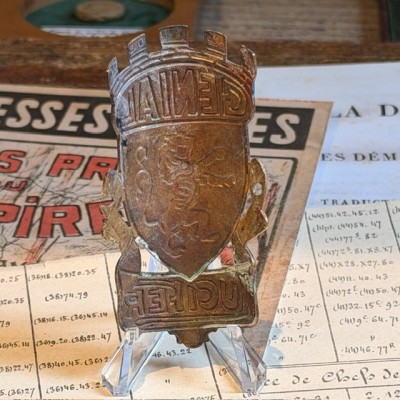
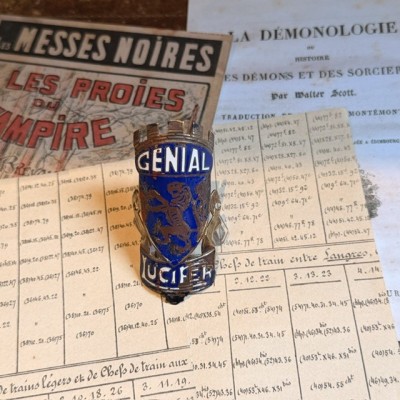
Period piece in brass characterized by its upper cut-out in crenellated crown.
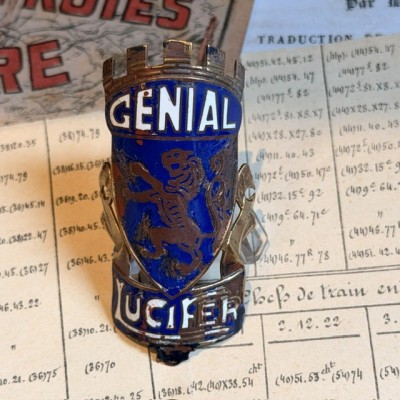
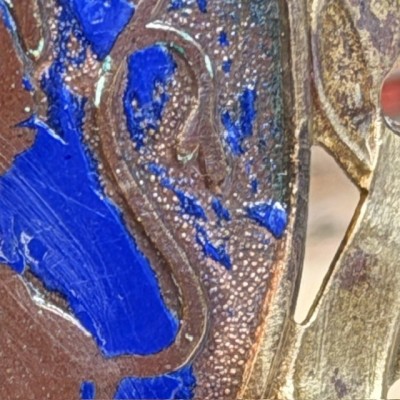
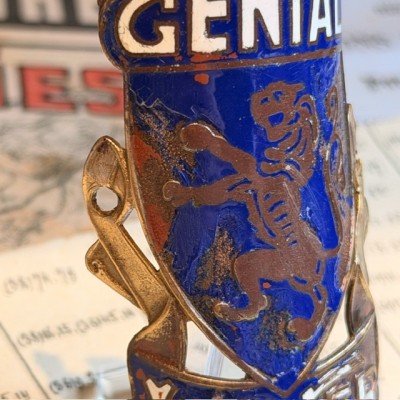
The heart of the coat of arms, enhanced with a deep blue enamel, bears the emblem of the brand: an imp.
Not to be confused with a lion!
The reliefs at the back of the plate better reveal the characteristic details of the devil: a head topped with small horns and the clearly forked tail (bifid) engraved in the matrix.
The lettering "GÉNIAL" and "LUCIFER" frame the embossed coat of arms on a white enamel background.
Blue and white enamel paint on a curved brass plate to fit on the frame of a bicycle.
Date from the 1930s with a very beautiful typography.
Why a name like that for a bike?
This plate bears witness to a major industrial alliance between the two world wars. It was born from the merger, in 1930, between the establishments Génial (a famous Lyon manufacturer of frames founded in 1907 by Louis Mouterde) and the Parisian brand of cycles Lucifer. The latter was created in 1902 by the supply house Mestre & Blatgé, located on avenue de la Grande-Armée in Paris.
The name Lucifer originally played on its Latin etymology Lux Fero, the bearer of light, evoking the progress of the time, but the company chose to illustrate it in a heraldic way by an imp.
This gave society Génial Lucifer!
During its golden age (from the 1930s to the 1950s), Génial-Lucifer will shine at the top of French cycling by equipping great champions of the Tour de France such as Charles Pélissier or Jean Robic, before ceasing production in 1956
Material: Brass, blue and white enamel.
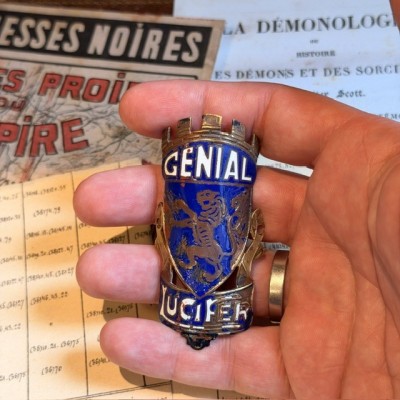
Dimensions: Height: 7cm - Maximum width: about 3cm
Condition: Authentic vintage. Natural oxidation and patina of time, enamel with cracks or minor gaps that highlight its history. The lateral attachment eyelets are intact.
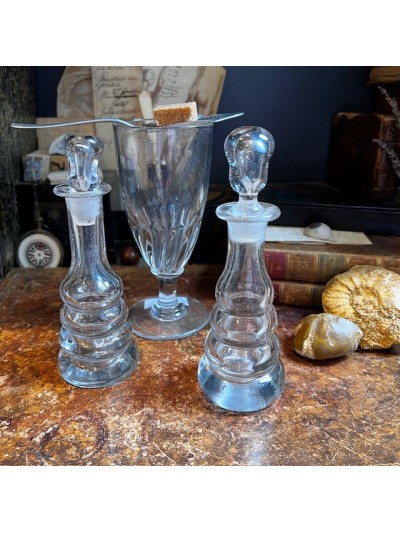
An antique absinthe topette (decanter)
4 Beaded Topette
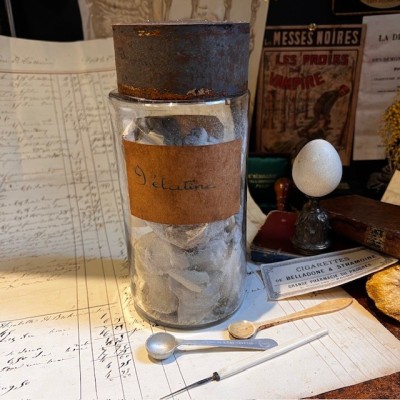
Gelatine
Antique pharmacy bottle - Wide-mouth apothecary jar.
19th-century mouth-blown glass
There is still some product left inside
A fascinating artifact from the history of pharmacology
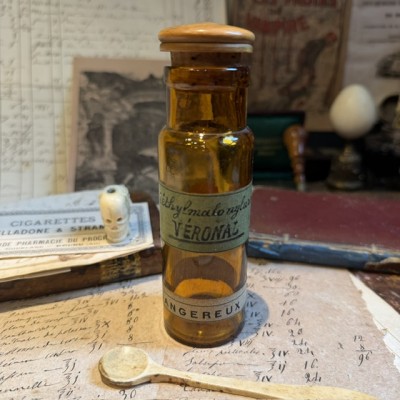
Veronal - Barbiturates - Diethylmalonylurea
Antique amber glass bottle, with a boxwood and cork stopper.
Label: DANGEROUS
Indicating to the pharmacist that it must be stored separately from other substances in the cabinet for toxic substances, the famous ‘poison cabinet’.
It comes from the former cellar-laboratory of a Parisian pharmacy. The bottles had not been moved from the shelves since the late 1950s. The cellar had served as a medical analysis laboratory and a laboratory for the pharmacy’s compounded preparations from 1900 until around 1950.
EMPTY
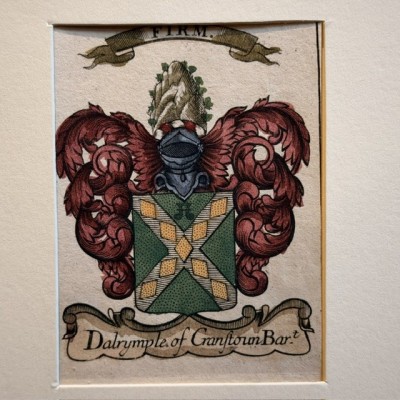
Original heraldic engraving on copper (1722) in colour - A System of Heraldry - By Alexander Nisbet
The vignette was cut from an original folio sheet and then hand-enhanced with a subtle watercolor painting.
The event is presented under a modern passe-partout
Coat of arms of the family: Dalrymple of Cranstoun
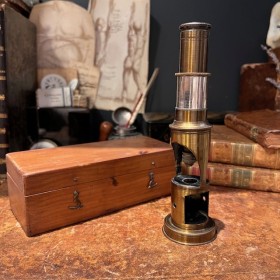
Antique drum microscope for botanist, entomologist
Mirror missing
Late 19th century, early 20th century
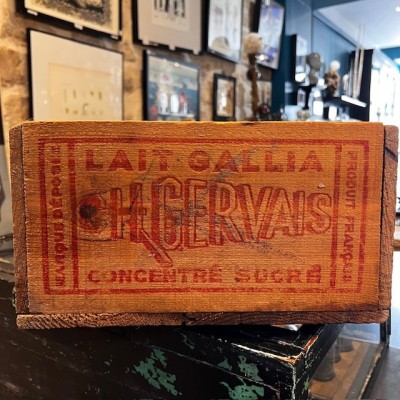
Antique wooden advertising crate for Gallia / Ch. Gervais infant milk concentrate
Found in Parisian cellars that served as laboratories and storage rooms for pharmacists preparing their masterful concoctions from 1900 to 1950.
It was used to store products, glass bottles, etc.
Period: Circa 1947–1955
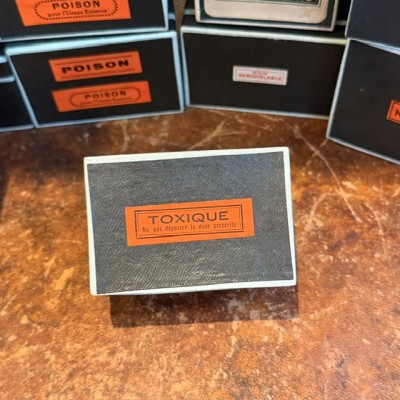
Antique labels in a pharmacy box for cures made of canvas cardboard
TOXIC label - Do not exceed the prescribed dose
The pharmacist used his boxes of medicine to put away the labels he would then put on the bottles that he would resell to his customers.
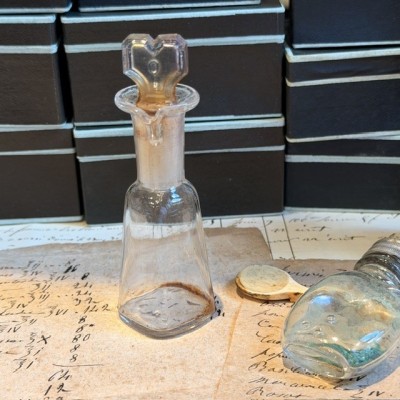
Square Section Dropper Bottle
Antique pharmacy bottle - 1920-30's
Glass stopper honed in the shape of a heart for better grip
EMPTY
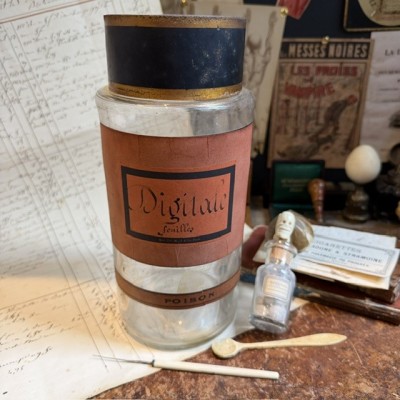
Foxglove leaves - POISON
Antique pharmacy bottle - 19th-century mouth-blown glass
Red POISON label
Signaling to the pharmacist that it is imperative to keep apart the other substances in the cabinet of toxic substances, the famous poison cabinet.
A fascinating testimony to pharmacology
It comes from an old cellar-laboratory in a Parisian pharmacy. The bottles had not moved since the late 1950s on the shelves. The cellar had served as a laboratory for medical analyses and a laboratory for magistral preparations of the pharmacy from 1900 until around 1950.
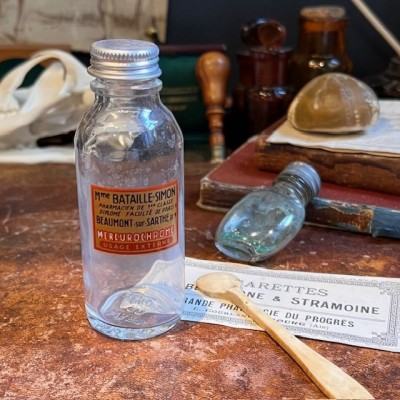
Mercurochrome
Antique pharmacy bottle - Apothecary
Mrs Bataille-Simon, First Class Pharmacist in Beaumont sur Sarthe - Tel 9
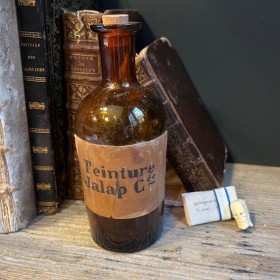
Tincture of Jalap Compound also known as German brandy
A purgative powder is extracted from the Jalap plant.
Antique pharmacy bottle
Apothecary vial
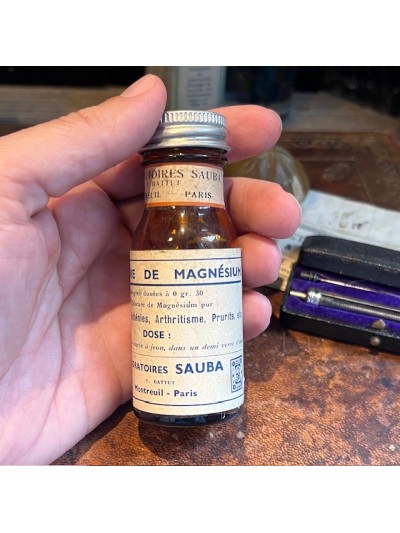
Chlorure de magnésium
Antique pharmacy bottle
Apothecary vial
EMPTY
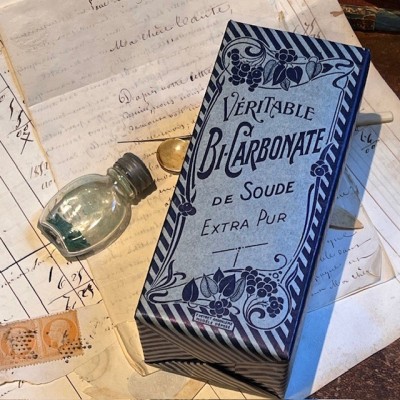
Bi-Carbonate de Soude - Sodium bicarbonate
Antique cardboard pharmacy box
Beautiful typography typical of the Belle Époque: circa 1910-1920
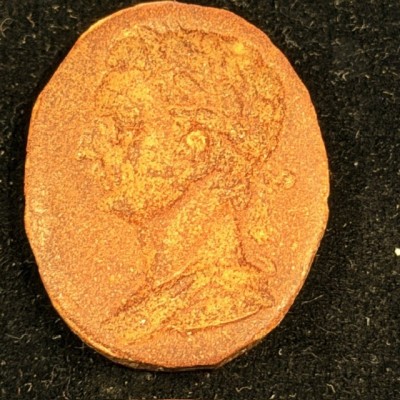
Antique intaglio and cameo print from the Grand Tour of the 19th century
In Brown Wax
True testimony of the Grand Tour carried out by the aristocrats in the 19th century
Profiles in the antique style, mythological scenes or Greco-Roman deities
Soufre sublimé - Sublimed sulfur
Pharmacy jar - Herbalism - Apothecary bottle
Orthoforme
Antique pharmacy bottle - Droguerie - Apothicaire
Silver medal at Paris 1889
"Génial Lucifer"- Vintage bicycle headbadge
Brass & Blue Enamel to be placed on the bicycle tube at the front
The 1930s