

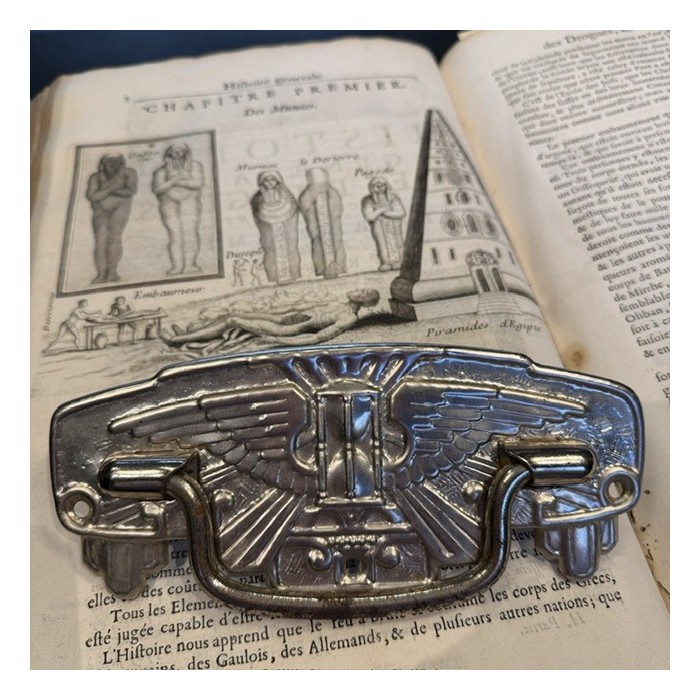
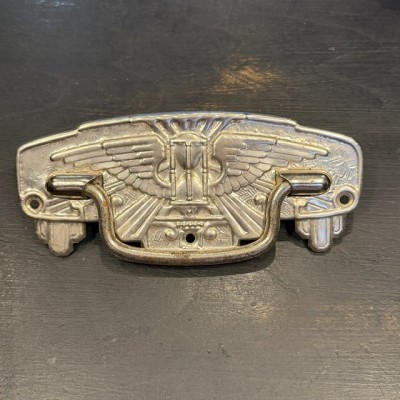
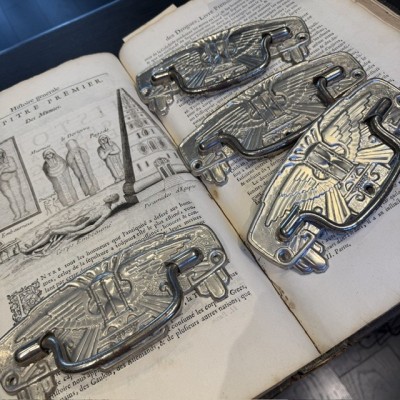
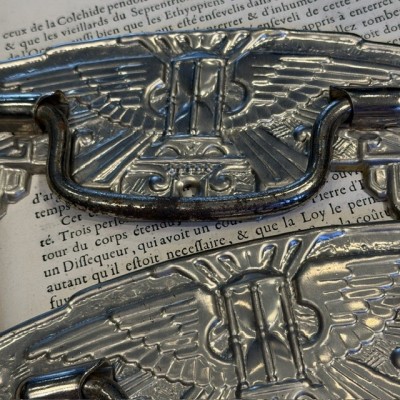
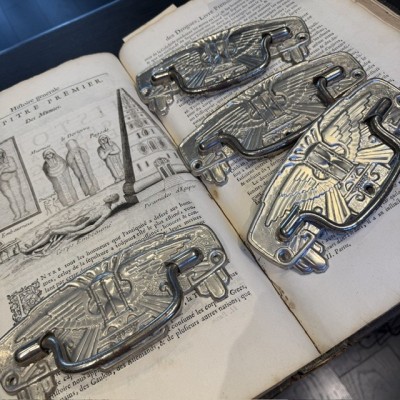
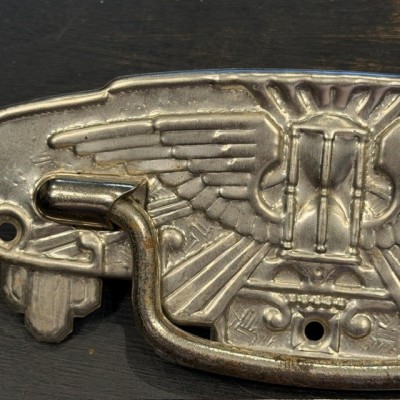
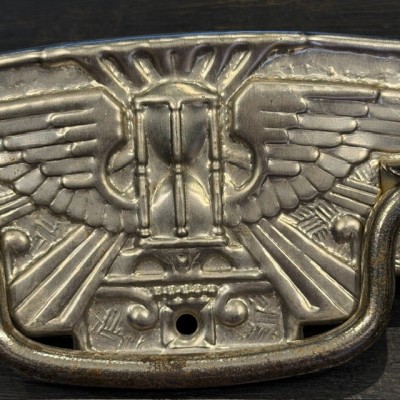
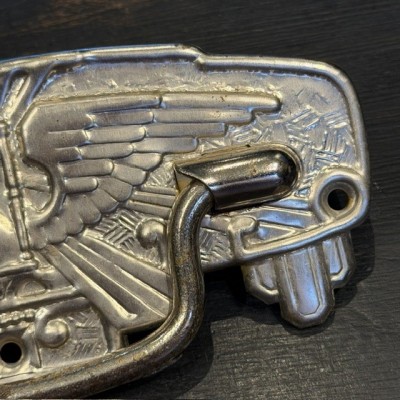
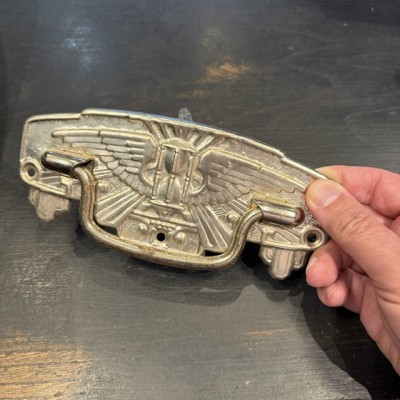
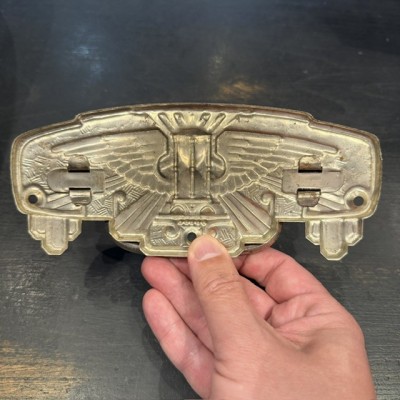
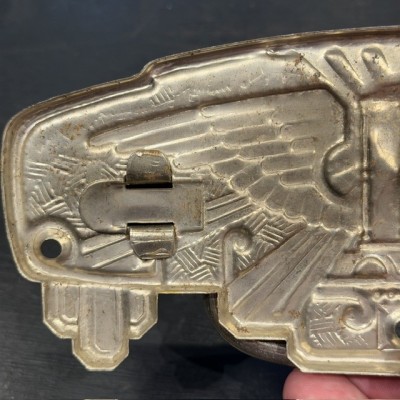
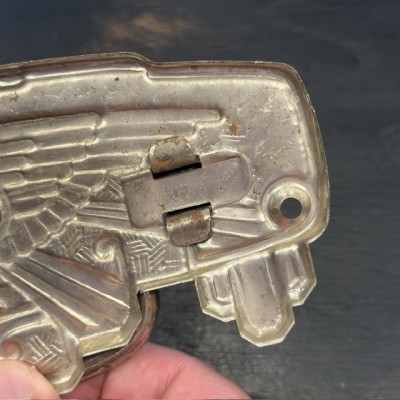
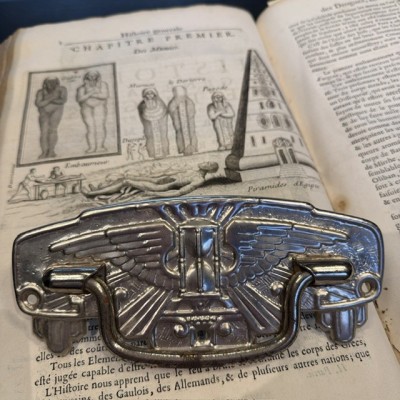
Antique Chrome-plated metal coffin handle
Winged hourglass motif
Art Deco period – 1925–1935
Some signs of oxidation on the handles
Brand new from the period; it has never been installed
Antique chromed-plated metal coffin handle
Featuring a winged hourglass motif.
This piece is from the height of the Art Deco period, featuring an Egyptian-inspired touch—a trend that emerged in Europe following the discovery of Tutankhamun’s tomb in 1922.
The stepped structure on the lower section evokes the skyscraper style, which was even found in lamps of the era and is typical of Art Deco. This must be a transitional model.
The hourglass evokes the inexorable passage of time, with each grain of sand representing a day of our lives.
The hourglass is depicted with the wings of a dove or an angel—both messengers of God—as if the instrument for measuring time were, upon death, the soul that the dove or angel will carry to heaven.
With its reversible design, the hourglass evokes the possibility of new life or true life when turned over to restart a cycle.
Would be perfect as a handle on a piece of furniture!
Brand new from the period, it has never been used.
In the past, coffin handles could also be purchased at hardware stores; these are often unsold stock from the era that has been rediscovered, as is the case here.
Size: 19x8.5cm
Some traces of oxidation on the handle itself
You buy 1 handle
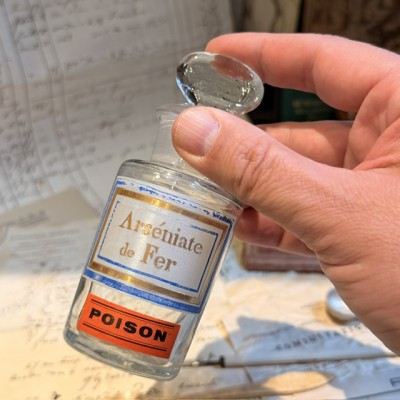
Arsenic - Iron arsenate
Antique pharmacy bottle made of blown glass and enameled painted label with golden blue threads
Red POISON label
Signaling to the pharmacist that it is imperative to keep apart the other substances in the cabinet of toxic substances, the famous poison cabinet.
Dating: 19th century
EMPTY
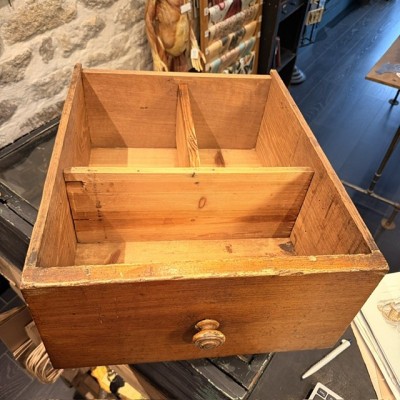
Large antique wooden pharmacy drawer with compartments - From a pharmacy or herbalist's cabinet
3 compartments
Ref C - 39.5x50cm
Can be used as a storage box
Weight: 4.1kg !
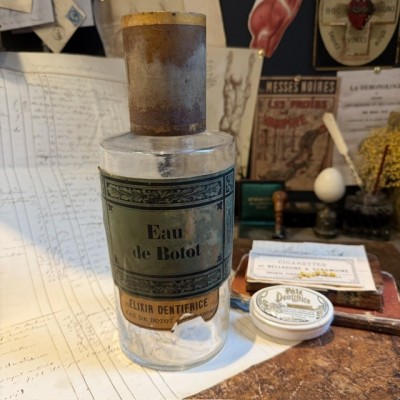
Eau de Botot - Tooth-cleansing Elixir
CODEX 1884
Antique 19th-century pharmacy bottle
EMPTY

Carbonate de Potasse
Antique pharmacy bottle
Early 20th century (circa 1910 - 1920)
EMPTY
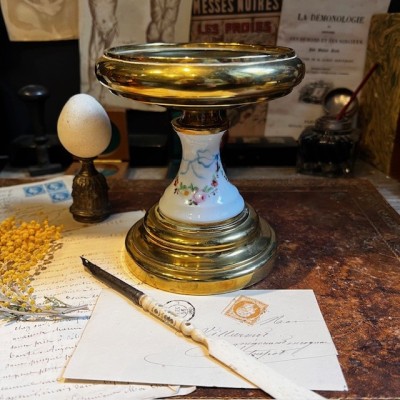
19th century oil or paraffin lamp stand
Made of brass with a Paris porcelain body painted with rose and ribbon motifs
Can be used as a support, pedestal or candle holder
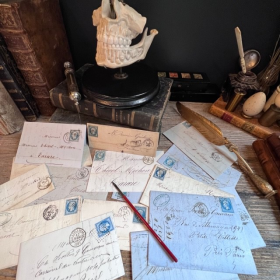
Stamped letter-envelope of the Second Empire
Dated from 1852-1870
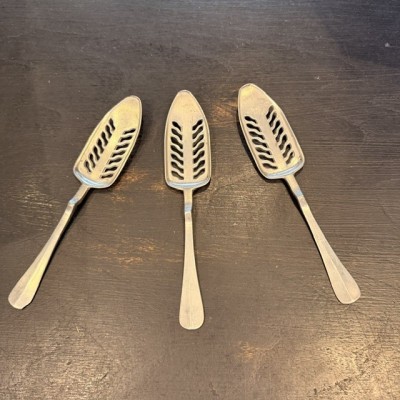
Antique Absinthe Spoon
The spoons have been used, are scratched, badly oxidized, etc.
You buy 1 spoon, not the whole lot

Antipyrina Knorr
Named after its German discoverer: Ludwig Knorr
Pharmacy jar - Herbalism - Apothecary bottle
Late 19th century

Solution N°153
Antique pharmacy bottle
Apothecary vial
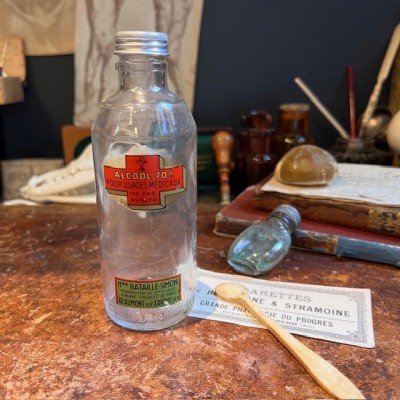
70° alcohol
Antique pharmacy bottle - Apothecary
Mrs Bataille-Simon, First Class Pharmacist in Beaumont sur Sarthe - Tel 9
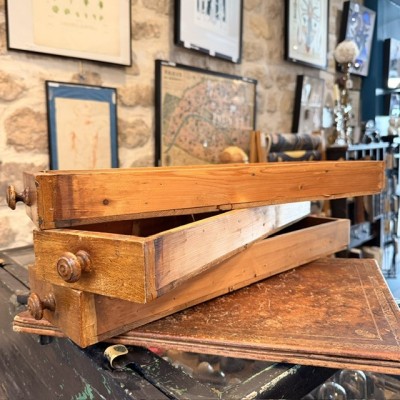
The apothecary’s Drawer - Size L
Antique wooden pharmacy drawer that can be used as a storage box - Craft Furniture Drawer
To be diverted on the shelf or niche for your curiosities
Antique hand-crafted manufacturing with dovetail joints and turned wooden pull knob
Width: 13cm - Length: 49cm - Height: 5cm
Sold empty, without accessories
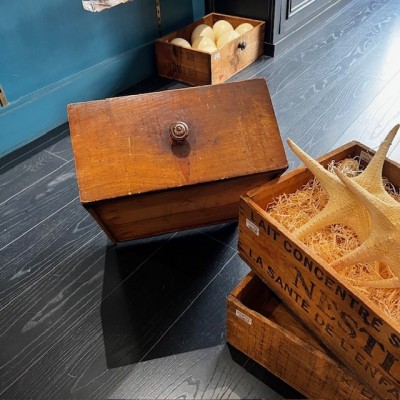
Large antique wooden pharmacy drawer with compartments - From a pharmacy or herbalist's cabinet
4 compartments
Ref A - 39.5x50cm
Can be used as a storage box
Weight: 4.1kg !
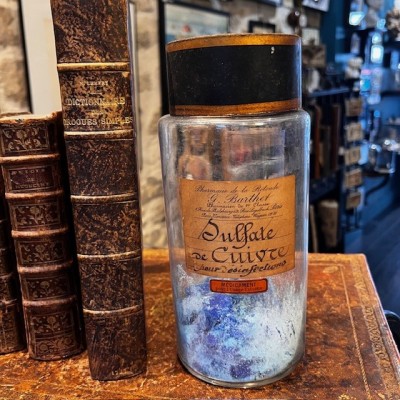
Copper Sulfate
Antique pharmacy bottle - Wide-mouth apothecary jar.
19th-century mouth-blown glass
There are still some beautiful blue crystals inside.
A fascinating artifact from the history of pharmacology
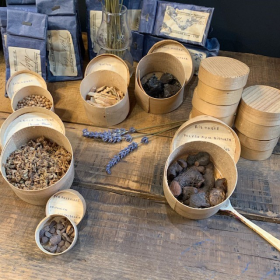
Antique wooden box for herbal medicine - Samples of plants, seeds, bark etc.
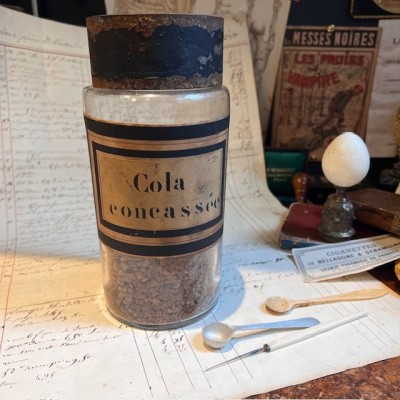
Crushed cola nuts
Antique pharmacy bottle - Wide-mouth apothecary jar.
19th-century mouth-blown glass
There is still some product left inside
A fascinating artifact from the history of pharmacology

Tétra-chlorure de Carbone - Carbon Tetrachloride
Antique pharmacy bottle with old label POULENC FRERES circa 1928
It comes from an old cellar-laboratory in a Parisian pharmacy. The bottles had not moved since the late 1950s on the shelves. The cellar had served as a laboratory for medical analyses and a laboratory for magistral preparations of the pharmacy from 1900 until around 1950.
EMPTY
Antique Chrome-plated metal coffin handle
Winged hourglass motif
Art Deco period – 1925–1935
Some signs of oxidation on the handles
Brand new from the period; it has never been installed