

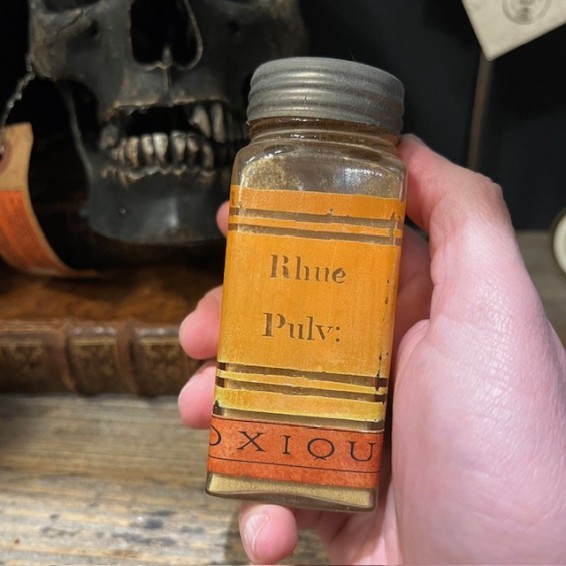
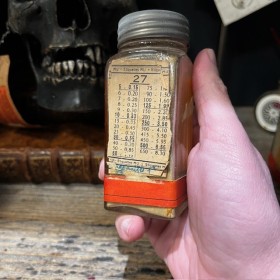
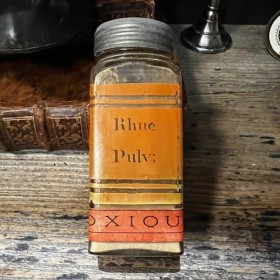
Rue Powder
Rue was an abortive plant
Antique pharmacy bottle - Poison - Toxic
Rue Powder
Rue was an abortive plant.
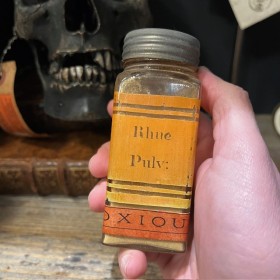
Stencilled label for product and red paper label for TOXIC
Antique pharmacy bottle - Poison - Toxic
Dimensions: square base 4.5x4.5cm Height: 11cm
Attractive orange label to draw the pharmacist's attention to the product's dangerousness
Metal cap
Remainder of product inside
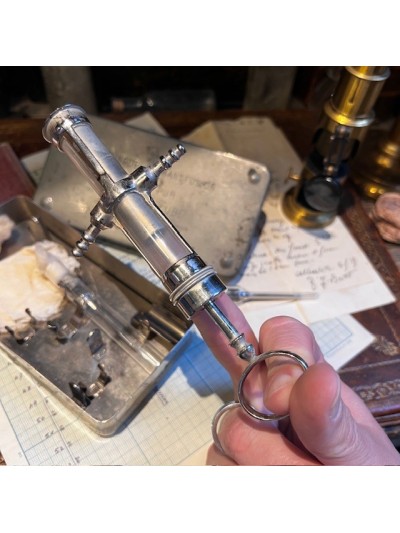
Doctor Louis Jubé pure blood transfusion syringe
For arm-to-arm transfusions
In its metal box
Around 1925/1930
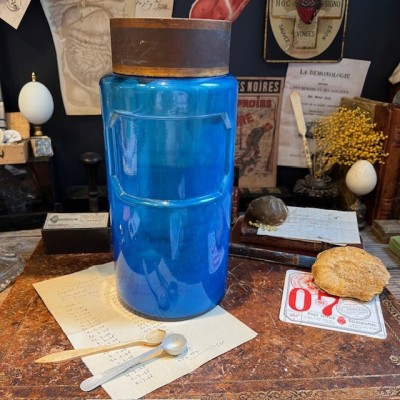
Cobalt blue glass pharmacy jar - Apothecary - Wide neck - H26cm - 19th
Apothecary jar with wide opening. Antique pharmacy bottle
Mouth-blown glass - Cobalt blue color tinted throughout
This large-capacity jar was a storage jar intended for stockpiling
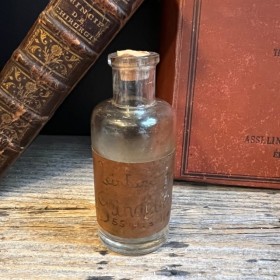
Grindelia Tincture
Antique medicine bottle
Apothecary
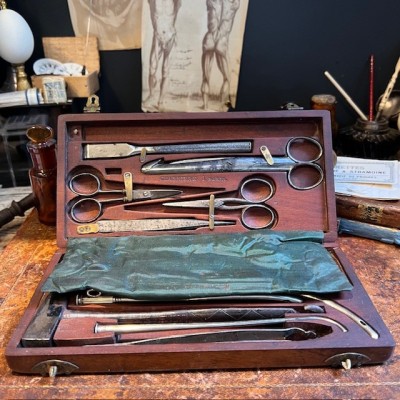
Portable autopsy kit from the mid-19th century
Maison Charrière in Paris, circa 1845–1870
Mahogany case for autopsy and dissection
Small portable mahogany case containing a set of autopsy instruments: hook hammer, bone chisel, enterotome scissors, probes, hooks and suture needles. Used by forensic scientists and anatomists for opening and examining bodies.
Charrière, a major 19th-century Parisian manufacturer, was a pioneer in the design of high-precision surgical and anatomical instruments.
Mahogany and polished steel: 23 × 11 cm
Please note: crack in the wood under the case
A beautiful object, very rare to find
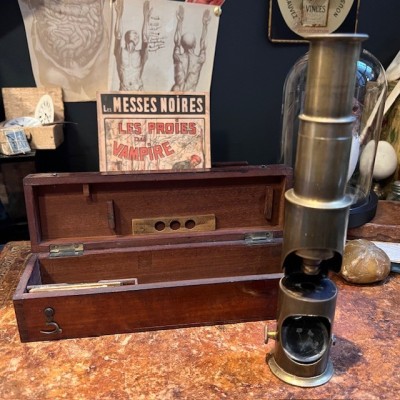
Antique and large drum microscope
In it's mahogany wooden box
For botanist, entomologist - XIXth century
This is a larger model than those usually found on the market
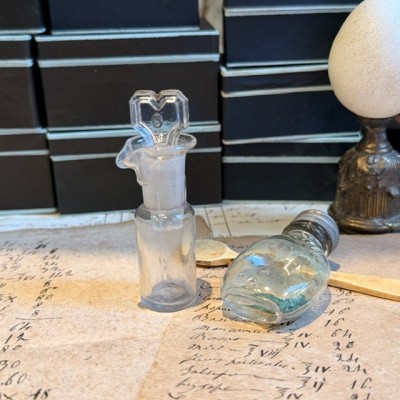
Dropper bottle
Antique pharmacy bottle - 1920-30's
Glass stopper honed in the shape of a heart for better grip
EMPTY
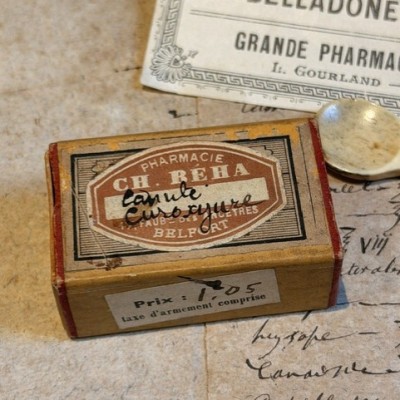
Polished bone cannula - New vintage stock - In its reusable box
Vintage medical device designed to remove pinworms
Marketed between May 1939 and sometime in 1940
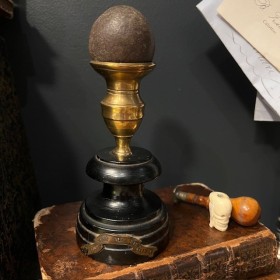
Antique bezoar - Antipoison - Antidote
Once sold by the apothecary, bezoar, also known as gallstone, was reputed to have the same anti-poison properties as the legendary unicorn's horn, hence its excessively high price, also due to its great rarity.
An important piece in a cabinet of curiosities
Sold alone - Without stand, sold separately
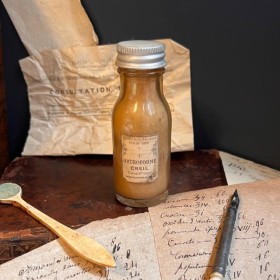
Orthoforme
Antique pharmacy bottle - Droguerie - Apothicaire
Silver medal at Paris 1889
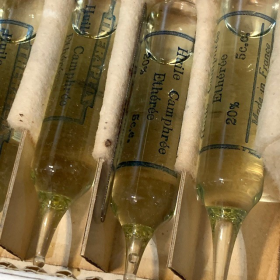
Bulb for hypodermic injection - Camphorated ethereal oil (circa 1920)
THERAPLIX
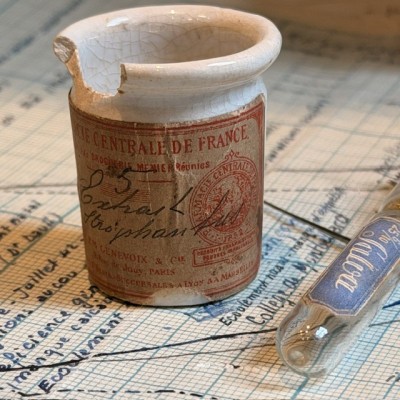
Excerpt from Strophanthus MENIER - TINY pot
Early/ mid-20th century pharmacy jar in white earthenware
Beautiful labels: Red POISON label with the famous skull and crossbones and the Poisonous Substances label
Signaling to the pharmacist that it is imperative to keep apart the other substances in the cabinet of toxic substances, the famous poison cabinet.
It comes from an old cellar-laboratory in a Parisian pharmacy. The bottles had not moved since the late 1950s on the shelves. The cellar had served as a laboratory for medical analyses and a laboratory for magistral preparations of the pharmacy from 1900 until around 1950.
EMPTY
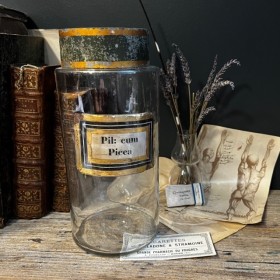
Cumin Epicea Pill - Pil: Cum Picea
Antique blown glass pharmacy jar
Apothecary
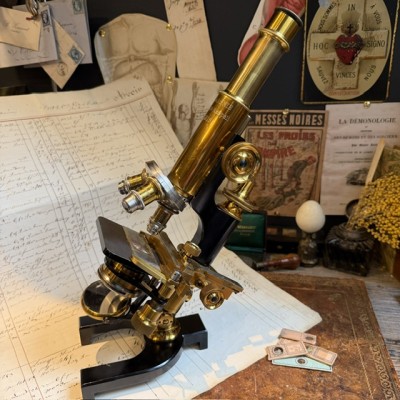
Stiassnie Microscope
Lacquered Brass Precision Microscope – M. Stiassnie, Paris, c. 1905/1908
In its mahogany case – Serial Number: 11765
Research microscope configuration with 3 objectives (including a 1/12 oil immersion objective), micrometric stage and Abbe condenser.
A rare collector’s item combining mechanical precision and Parisian scientific prestige.
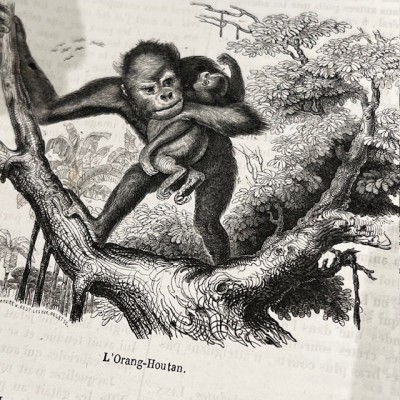
Le Jardin des Plantes
Description and habits of the mammals in the menagerie and the Natural History Museum
By Boitard - Antique book circa 1851
A beautiful snapshot of the museum and its garden in the mid-19th century, featuring interiors of the museum that no longer exist today.
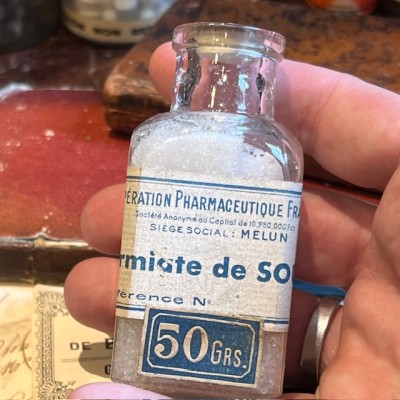
Sodium formate
Antique pharmacy bottle - Apothecary
There is still some product left inside
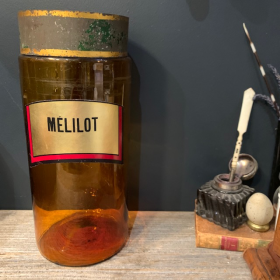
Rue Powder
Rue was an abortive plant
Antique pharmacy bottle - Poison - Toxic