
- New
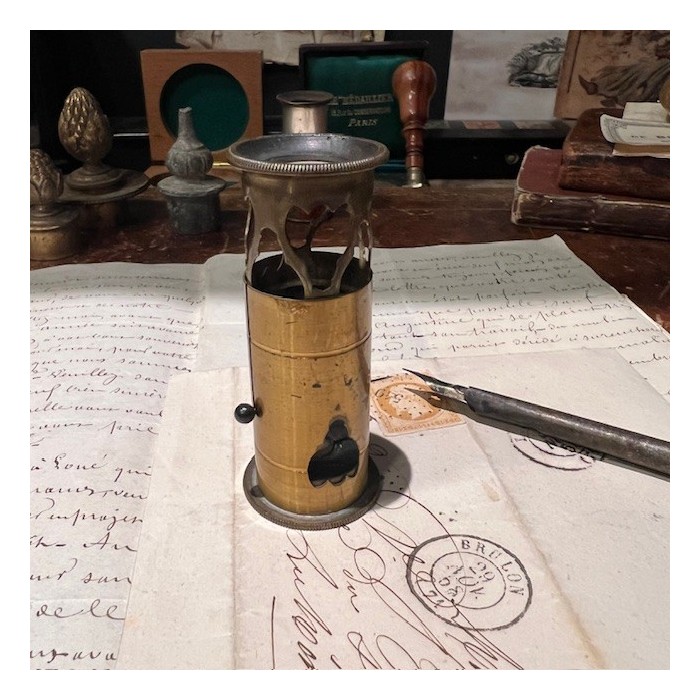
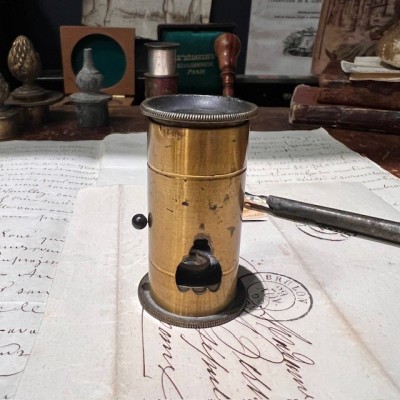
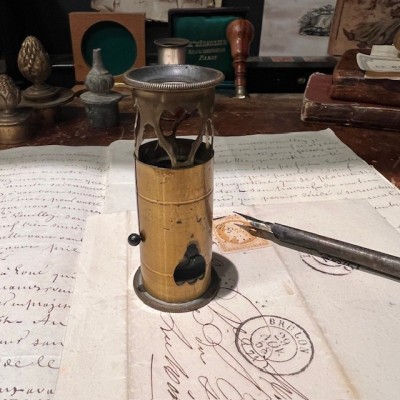
Floroscope - Ref A
Botanist's microscope
Pocket microscope Late 19th - early 20th century
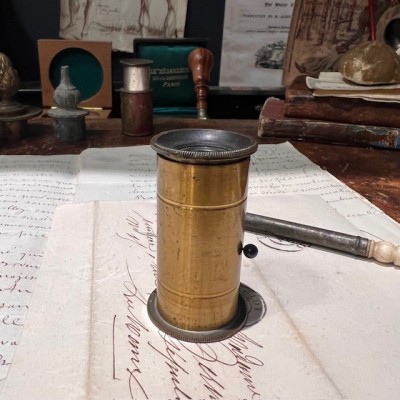
Floroscope - Brass insectoscope - pocket microscope
These small microscopes, also known as Floroscopes or botanist's microscopes, were sold in France from the 1850s to the 1930s.
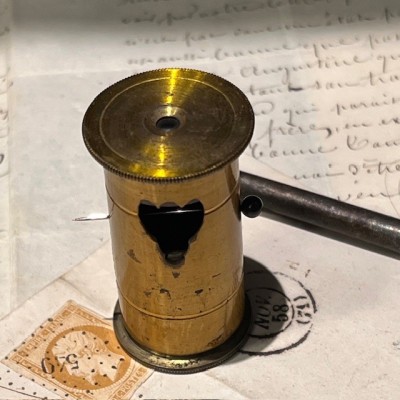
These small pocket microscopes, made of brass and glass lenses, enabled rapid observation of insects, small minerals, flowers etc. in nature.
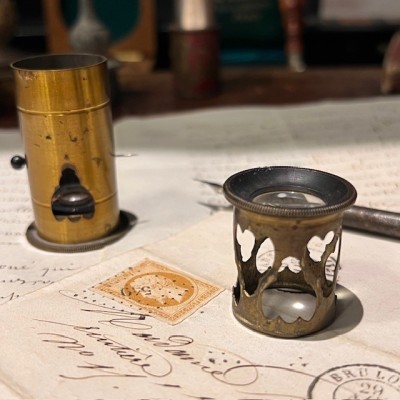
The ingenious thing about them is that they are made up of 2 parts:
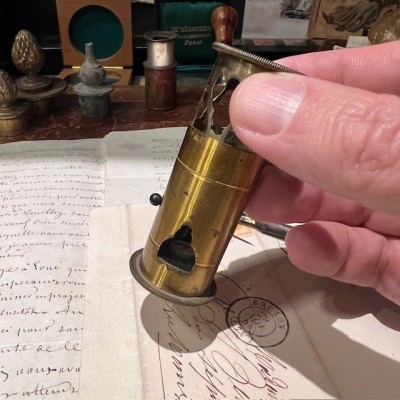
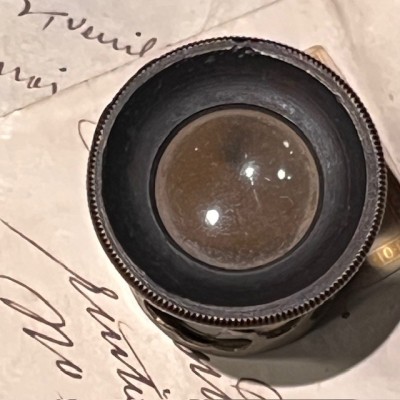
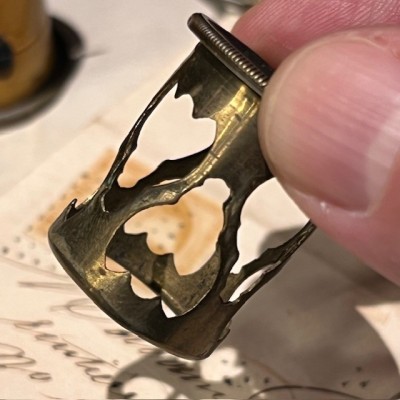
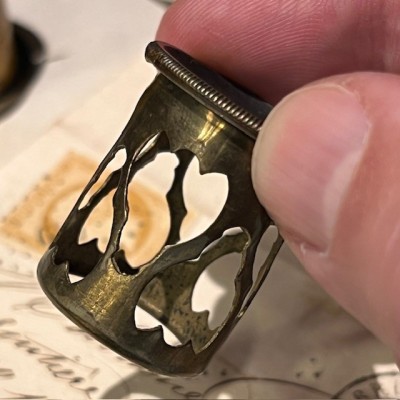
The first, for observations requiring low magnification, is a biconvex lens mounted on a beautifully openwork cylinder. Remove the cage and place the lens on whatever you wish to magnify with the lens.
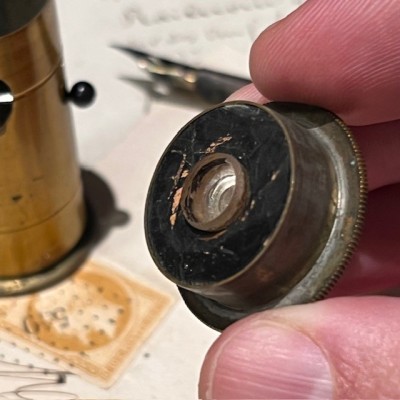
The second, for magnifications of over ten times, is the Stanhope lens. The Stanhope lens is very rudimentary, consisting of a glass cube, prism or cone with a flat surface.
The needle shown here (not original) was used to pierce the object or insect to be observed and placed under the simple lens.
Late 19th - early 20th century
Perfect for any self-respecting budding entomologist!
Height unfolded: 7.5cm Closed: 4.5cm Diameter: 2.8cm
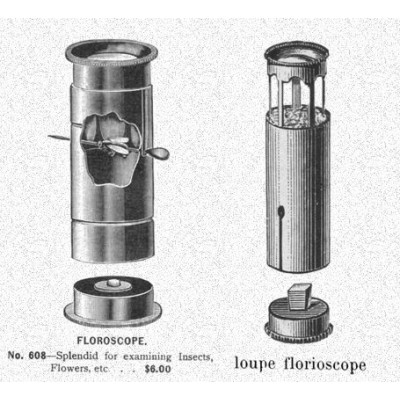
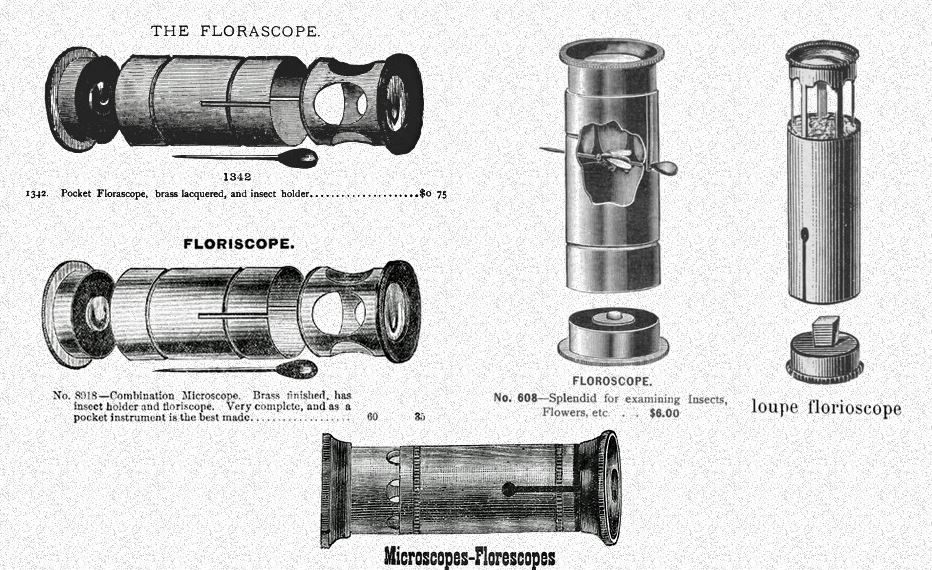
Here's an illustration of what this floroscope looked like in a period advertisement:
(Source: The Compendium - www.lecompendium.com)
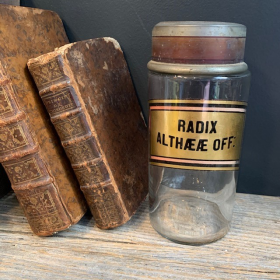
Antique 19th century pharmacy bottle
Radix althaeae Off - Marshmallow
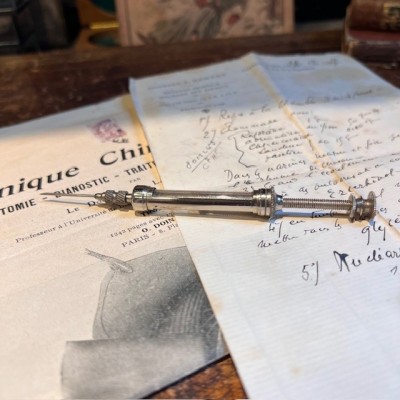
Pravaz hypodermic injection syringe
Early 20th century
Non-functional
SOLD ALONE WITHOUT CASE
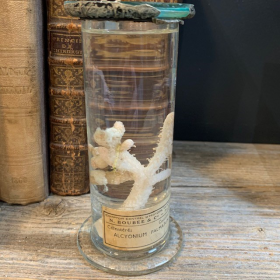
Museum jar - Wet specimen
Soft coral Alcyonium palmatum
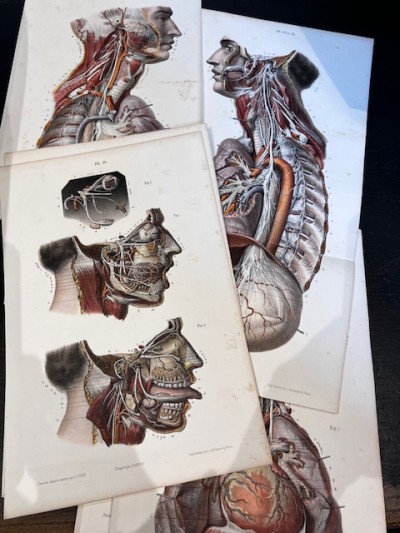
Anatomical chart by Ludovic Hirschfeld drawn by Léveillé
From Traité et iconographie du système nerveux et des organes des sens de l'homme avec leur mode de préparation
Published in 1866
Lithography
You buy 1 plate, not the whole set
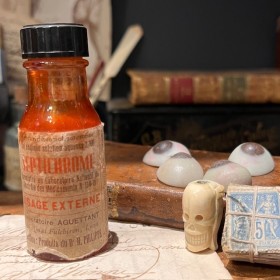
Septichrome
Antique pharmacy bottle
Apothecary vial
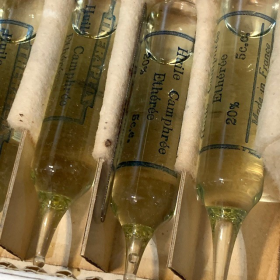
Bulb for hypodermic injection - Camphor (circa 1920)
THERAPLIX

Anatomy - Antique chart by D'Orbigny - 1869
In colors
Atlas of the Universal Dictionary of Natural History
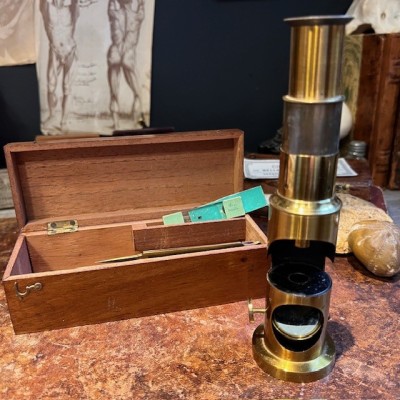
Antique drum microscope
With its wooden case containing 1 brass clamp and 2 preparation slides
XIXth century - inscription under the case dated 7 or 8 May 1853
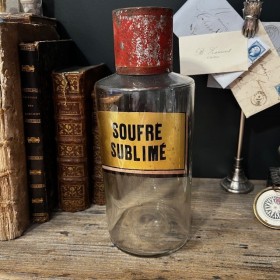
Soufre sublimé - Sublimed sulfur
Pharmacy jar - Herbalism - Apothecary bottle
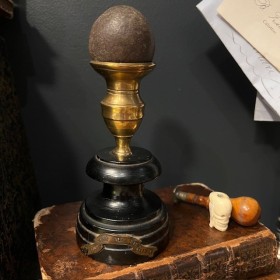
Antique bezoar - Antipoison - Antidote
Once sold by the apothecary, bezoar, also known as gallstone, was reputed to have the same anti-poison properties as the legendary unicorn's horn, hence its excessively high price, also due to its great rarity.
An important piece in a cabinet of curiosities
Sold alone - Without stand, sold separately
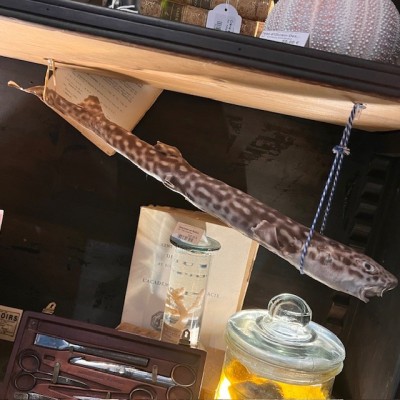
Naturalized Small-spotted catshark
Scyliorhinus canicula
Unprotected species - Old taxidermy: visible suture under the belly and on the left side near the mouth

Botany plate by Édouard-Adolphe Duchesne
From the Atlas du Répertoire des plantes utiles et des plantes du globe published in 1846
19th-century color lithograph
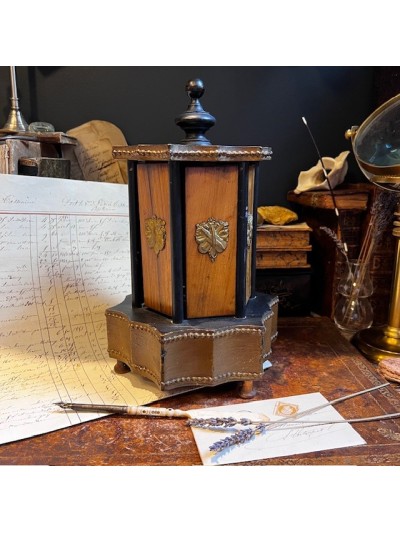
Cigar cabinet- Cylindrical cigar box - Cigar cellar
Napoleon III period
When you turn the knob, the doors open pretty well except for 1 or 2, but this is not the case for closing, you have to close the doors manually.
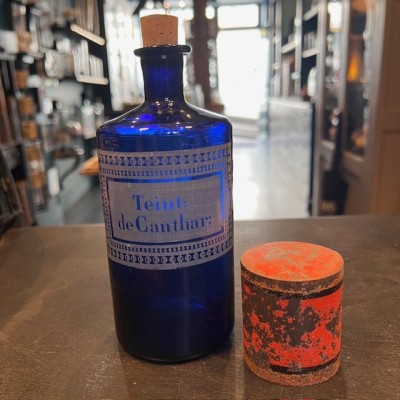
Teinture de Cantharides - POISON
Lytta vesicatoria - Spanish fly
Antique blue glass pharmacy bottle - Apothecary
Early 20th century - Blown glass.
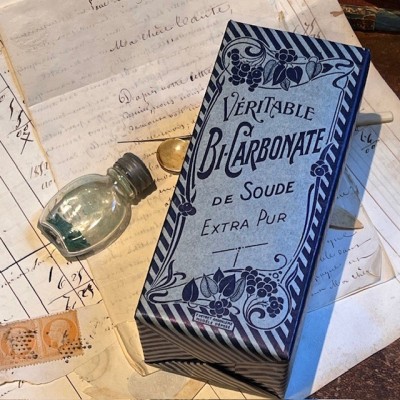
Bi-Carbonate de Soude - Sodium bicarbonate
Antique cardboard pharmacy box
Beautiful typography typical of the Belle Époque: circa 1910-1920

Antipyrina Knorr
Named after its German discoverer: Ludwig Knorr
Pharmacy jar - Herbalism - Apothecary bottle
Late 19th century
Floroscope - Ref A
Botanist's microscope
Pocket microscope Late 19th - early 20th century